

The types of electric motors you choose significantly impact the performance of your power drive system, whether for industrial material handling, warehouse logistics, medical equipment transport, or outdoor utility applications. Two popular options to consider are brushless motors versus brushed motors.
This raises critical questions for buyers and industry professionals: What’s the difference between the two? And how do these differences affect overall system operation and performance? More importantly, why is investing in a brushless power drive system a smarter and more cost-effective choice for long-term operational needs?
Overview of Brushless Motor vs Brushed Motor
Motors in a power drive system convert supplied electric energy into mechanical energy. To understand the disparities between brushed and brushless motors, it is first essential to grasp their core operating principles—specifically, how they achieve commutation, the process of reversing the direction of current in the motor’s windings to maintain continuous rotation.
1. What is a Brushed Motor?
A brushed DC motor features permanent magnets fixed inside its outer casing, forming the stationary stator. A rotating armature, known as the rotor, is positioned within. The rotor consists of copper windings that function as an electromagnet.
Its operation is straightforward: it relies on a mechanical commutator and stationary carbon brushes to deliver current. As the commutator rotates, electricity is supplied through the brushes to the copper windings. This current interacts with the magnetic field from the stator magnets, generating torque that causes the rotor to turn.
Brushed motors are generally simple, affordable, and easy to control. However, the physical contact between the brushes and commutator leads to friction, sparking, and eventual wear, requiring periodic maintenance and replacement.
2. What is a Brushless Motor?
As the name implies, the electric motor DC brushless completely eliminates the physical carbon brushes and mechanical commutator, instead using electronic commutation, regulating the current through sensors (usually Hall effect sensors) and an electronic speed controller (ESC). The motor’s windings are mounted on the stator, while permanent magnets are attached to the rotor. During operation, the sensors continuously detect the position of the rotor and relay this information to the ESC. The controller then precisely switches the current direction in the stator windings, generating a rotating magnetic field that drives the rotor’s permanent magnets. This contactless design removes the friction and wear inherent in brushed motors, leading to smoother operation, reduced heat generation, and higher efficiency.
What is the Difference Between Brushed vs Brushless Motors?
Now that you are well aware of these two types of motors, here’s a detailed explanation of their key differences:
1. Efficiency & Runtime
Brushed motors exhibit relatively low efficiency, mainly because of the energy losses caused by continuous physical contact between the commutator and brushes. This contact creates friction, which converts a portion of the motor’s electrical energy into heat (wasted energy) rather than mechanical power. Brushless motors, with their contactless electronic commutation, avoid this energy loss, as nearly all electrical energy is converted directly into mechanical power.
2. Lifespan & Durability
The lifespan of a brushed motor in a power drive system is directly limited by the wear of its carbon brushes and commutator. As the brushes slide against the commutator over time, they gradually erode, and the commutator becomes worn or pitted. This wear usually brings about a noticeable decline in performance (e.g., reduced speed or power). Additionally, the friction and heat generated by physical contact render brushed motors more susceptible to failure in harsh environments.
Electric motor DC brushlesses, lacking wearable components like brushes and a commutator, usually have a far longer lifespan, which can last for tens of thousands of hours. Their sealed design also makes them more resistant to shock, vibration, and environmental stress, enhancing overall durability.
3. Maintenance
Brushed motors demand regular maintenance to compensate for brush and commutator wear. Users must periodically inspect the brushes for erosion, clean the commutator to remove carbon dust (a byproduct of brush wear), and replace worn brushes. If maintenance is neglected, carbon dust can accumulate inside the motor, causing short circuits or motor failure. In contrast, a brushless power drive system is virtually maintenance-free.
4. Performance & Control
Brushed motors struggle with consistent performance, especially at low speeds or under heavy loads. The friction between brushes and commutator causes brush bounce (intermittent loss of contact), which leads to uneven torque output, noise, and vibration.
A brushless power drive system offers superior performance and precise control. They allow for smooth, consistent torque delivery across all speed ranges, from low idle speeds to high operating speeds, with minimal noise or vibration. They also have a higher power-to-weight ratio, making them lighter and more compact while delivering greater power.
5. Total Cost of Ownership
Despite a higher upfront cost, brushless power drive kits achieve a lower Total Cost of Ownership (TCO). Their extended lifespan, minimal maintenance requirements, and high energy efficiency significantly reduce ongoing operational expenses.
Ideal Applications for Brushless Power Drive Systems
Given their advantages in efficiency, durability, and performance, brushless power assist systems are particularly well-suited for applications that demand reliability, long runtime, and minimal downtime.
(1) The exceptional energy conversion efficiency of brushless power drive systems considerably prolongs operating duration per battery cycle and minimizes workflow disruptions, benefiting warehouse sorting systems and inter-facility material handling.
(2) In applications that routinely involve moving heavy loads or traversing inclined paths, brushless drive kit systems deliver consistent high-torque output even at low rotational speeds. This effectively mitigates speed variations and power drops commonly encountered with conventional motors during hill ascent or high-load activation.
(3) Owing to the absence of wear-prone components like carbon brushes and commutators, they require almost no regular part replacements. This characteristic showcases a distinct advantage in environments such as high-speed logistics centers, large production lines, or remote locations..
(4) Finally, the sealed design and robust environmental resistance ensure reliable performance in demanding conditions, including dust, humidity, and extreme temperatures, with applications in food processing or chemical manufacturing.

Get a Reliable Power Drive System with Rotontek
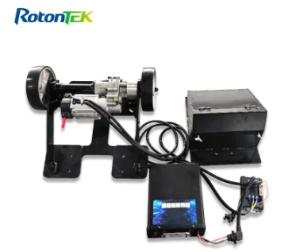
If you are looking for a highly durable and efficient power drive kit tailored to your unique industrial needs, Rotontek offers the ultimate solution. Our Power Trolley Kit features a modular design for effortless installation, allowing you to deploy it quickly and minimize downtime. With exceptional torque output, smooth operation, and significantly reduced noise levels, it stands out as a smart long-term investment that enhances productivity while lowering operational costs.
Don’t miss the opportunity to elevate your operations with a system built for performance and reliability. Get in touch with us today to learn more or request a customized solution!
[…] electric drive axle uses a brushless DC motor available in 150 W, 250 W, and 300 W configurations. This motor design showcases several […]