

In automated logistics and smart warehousing, the precise movement and flexible steering capabilities of AGVs represent their core value. These capabilities directly determine the overall efficiency, reliability, and handling quality of the entire system. With growing industry demands for operational flexibility and efficiency, AGVs are now required to execute complex path planning with higher precision and achieve rapid yet stable posture adjustments even in confined spaces.
As professional motor controller manufacturers, Rotontek thoroughly understands these evolving challenges. This insight has driven the development of our advanced dual motor controller, designed specifically to meet the precise motion control requirements of modern AGV systems.

Principles and Challenges of ACV Movement and Steering
1. The Underlying Logic of AGV Movement and Steering
The fundamental movement and steering actions of an AGV are based on the classic differential steering model. The vehicle body typically consists of left and right drive wheels (or two sets of drive wheels) along with several load-bearing caster wheels. By precisely controlling the speed difference between the left and right drive wheels, all basic motion modes can be achieved:
- Straight-line travel: The left and right wheels rotate at the same speed and in the same direction.
- Curve steering: The left and right wheels turn at varying speeds while rotating in sync (e.g., when turning left, the speed of the right wheel > the speed of the left wheel).
- Center spin: The left and right wheels turn in unison but in opposing directions.
Although this principle seems simple, translating theory into stable and precise action in practical applications presents numerous severe challenges.
2. Pain Points in AGV Movement and Steering
(1) Straight-line Deviation
Ideally, the speeds of the left and right wheels should be identical. However, in reality, minor differences in the internal resistance and magnetic flux characteristics of the two motors, coupled with uneven AGV load distribution or ground surface irregularities, lead to varying resistance on each side’s wheels. Even with identical control signals, slight differences in the actual wheel speeds occur. Over time, this causes the AGV to deviate from the intended straight path, requiring constant correction from the navigation system, which impacts operational smoothness.
(2) Imprecise Steering
During differential steering, the required coordination between the left and right wheel speeds is extremely high. If speed control is uncoordinated or non-linear, the AGV cannot follow the intended turning radius, leading to path deviation. More commonly, improper acceleration and deceleration control at the start and end of a turn causes body shaking or “weaving,” severely affecting operational stability and positioning accuracy.
(3) Sluggish Response
There is a delay between the command issued by the upper control system and the motor’s execution and attainment of the target speed. If the controller processing speed is slow or the motor response is lagging, the AGV reacts slowly. This is critical in scenarios requiring precise stopping or emergency obstacle avoidance, directly reducing operational efficiency and system reliability.
(4) Range Anxiety
AGVs in warehouses frequently start, stop, accelerate, decelerate, and turn, representing typical dynamic operating conditions. Inefficient motor control strategies can cause large current surges, generating significant unnecessary heat loss and energy waste. This shortens the AGV’s continuous operating time, increases charging frequency, and constrains the ability for 24/7 uninterrupted operation.
How the ID200 Dual Motor Controller Works
Facing the numerous pain points in AGV motion control, our ID200 dual motor controller offers a systematic solution rather than a simple accumulation of features.
1. High-Precision Synchronous Control
ID200 dual motor controller employs an advanced sinusoidal vector control algorithm, enabling independent and precise decoupling control of the motor’s torque and magnetic flux components. This allows the controller to directly and rapidly adjust the motor’s output torque, rather than merely controlling its speed.
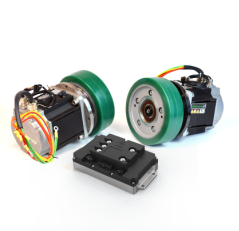
- When the AGV experiences uneven load distribution or uneven road surfaces, the controller can instantly increase the torque output of the motor on the side with greater resistance, thereby suppressing straight-line deviation at its source.
- The built-in automatic motor load compensation function detects load changes in real time. During obstacle crossing or slope climbing, the controller automatically increases torque to maintain the preset speed, ensuring stable vehicle speed under dynamic loads and preventing stuttering or stoppage caused by load impact.
2. Rapidly Responding Differential Commands
Leveraging the powerful processing capabilities of the DSP, the ID200 dual motor controller can parse and execute differential commands from the upper-level system within milliseconds.
- Soft Start/Stop and Intelligent Braking: This eliminates the jolt and “nodding” effect during starting and stopping, enhancing ride comfort and protecting both mechanical structures and cargo. The optimized control algorithm ensures linear speed transitions during turns, preventing body shake and weaving for precise steering.
- Anti-Rollback Function: On slopes, the controller automatically applies holding torque to prevent the AGV from rolling backward, significantly improving operational safety.
3. Comprehensive Protection Mechanisms
Our ID200 dual motor controller incorporates comprehensive diagnostics and protection against accelerator faults, overvoltage, undervoltage, overcurrent, overload, and overheating.
Energy regeneration technology converts kinetic energy into electricity during deceleration, feeding power back to the battery to extend range and alleviate range anxiety.
With an IP55 protection rating, the ID200 dual motor controller resists dust and water ingress, ensuring reliable operation in demanding warehouse environments.
4. Highly Integrated System Architecture
The compact integrated design combines dual motor drive, control, and protection circuits, saving space, reducing wiring complexity, and minimizing potential failure points.
Hall sensor auto-identification simplifies motor wiring debugging. Engineers can use a programmer to adjust parameters like speed, acceleration, and torque limits for optimal performance across different scenarios and road conditions.
The electric motor controller supports software customization to meet specific customer needs, enabling functional expansion for specialized applications.

Upgrade Your AGV Performance With Rotontek
In today’s era of increasingly stringent demands for efficiency and precision in automated logistics systems, the precise movement and flexible steering capabilities of AGVs are at the core of their competitiveness.
Our Rotontek dual brushless DC motor controller delivers high-precision closed-loop synchronous control, rapid differential response, and a highly integrated system architecture, transforming simple wheel rotation into stable, efficient, and reliable intelligent motion. To achieve even better synchronization for smoother straight-line travel and more fluid turning, we recommend pairing the controller with Rotontek high-resolution encoder motors.
If you are looking to enhance the control accuracy and operational efficiency of your AGVs, feel free to contact us for detailed technical information and customized solutions.