

The drive axle is a key part of an industrial floor-cleaning machine. It converts motor output into controlled wheel movement and must operate reliably during frequent starts, turns, stops and changes in floor conditions. Choosing the right floor scrubber drive axle requires more than matching a motor wattage: vehicle weight, brush and solution load, tire size, travel speed, gradient, noise and available installation space all matter.
1. Understand the Cleaning Machine’s Operating Conditions
Start by defining the machine type and its working environment. A compact walk-behind scrubber, ride-on floor scrubber and larger industrial cleaning vehicle can have very different load and speed requirements. Record the machine’s curb weight, maximum operating weight, target travel speed, tire diameter, turning requirements, ramp capability and expected daily operating hours.
2. Choose Between Brushed and Brushless Motors
Brushed DC motors can be attractive where simple control and cost are priorities. Their brushes are wear components and require periodic inspection or replacement. Brushless DC (BLDC) motors eliminate mechanical brushes and can offer a compact, efficient drive with electronic commutation, but they require a compatible controller and correct configuration. The better choice depends on lifecycle cost, duty cycle, control requirements and service strategy.
3. Calculate Wheel Torque and Gear Ratio
The axle must provide enough tractive effort to move the fully loaded machine, start smoothly and handle the required gradients. Wheel torque depends on the required tractive force and wheel radius. Gear ratio then matches motor speed to the target wheel speed while multiplying torque, subject to drivetrain losses. Review continuous and peak operating conditions rather than relying on a single nominal figure.
4. Match Motor Power, Voltage and Controller
Confirm the battery voltage range and the machine’s electrical architecture. Check motor rated power, continuous current, peak current, controller limits, thermal conditions and the control signal expected from the machine. The controller must be matched to the motor type and should support the required acceleration, speed regulation, braking and direction functions.
5. Consider Noise and Vibration
Floor-cleaning machines often operate in offices, retail spaces, hospitals, warehouses and other occupied environments. Gear design, motor control, mounting stiffness, tire selection and machine structure all influence perceived noise and vibration. If low-noise operation is important, request test data with clearly stated conditions and evaluate the complete machine rather than comparing isolated motor claims.
6. Confirm Mechanical Fit and Protection
-
- Axle overall length, track width and mounting-hole pattern.
-
- Wheel hub, shaft diameter, keyway or other output interface.
-
- Ground clearance and clearance around the chassis.
-
- Brake type and required parking or emergency stopping function.
-
- Cable routing, connector position and controller mounting space.
-
- Exposure to cleaning chemicals, water splash, dust and vibration.
-
- Access for inspection, replacement and routine service.
Why Consider an Integrated Drive Axle Kit?
A matched drive package can combine the axle or transaxle with a motor and selected electrical accessories such as a controller, throttle and wiring harness. This can simplify sourcing and integration, provided the package is configured for the machine’s voltage, control interface, mounting dimensions and required operating performance. Confirm the included components and any vehicle-side wiring or bracket work before ordering.
Rotontek LDM22-355 Series for Cleaning Equipment Projects
Rotontek’s LDM22-355 family includes configurations used in low-speed electric vehicle and cleaning-machine applications. The exact motor type, voltage, rated power, gear ratio, axle dimensions and controller combination vary by configuration. For example, a 24V brushed configuration and a 36V brushless kit are not interchangeable specifications. Confirm the precise model code and current datasheet before engineering approval or quotation.
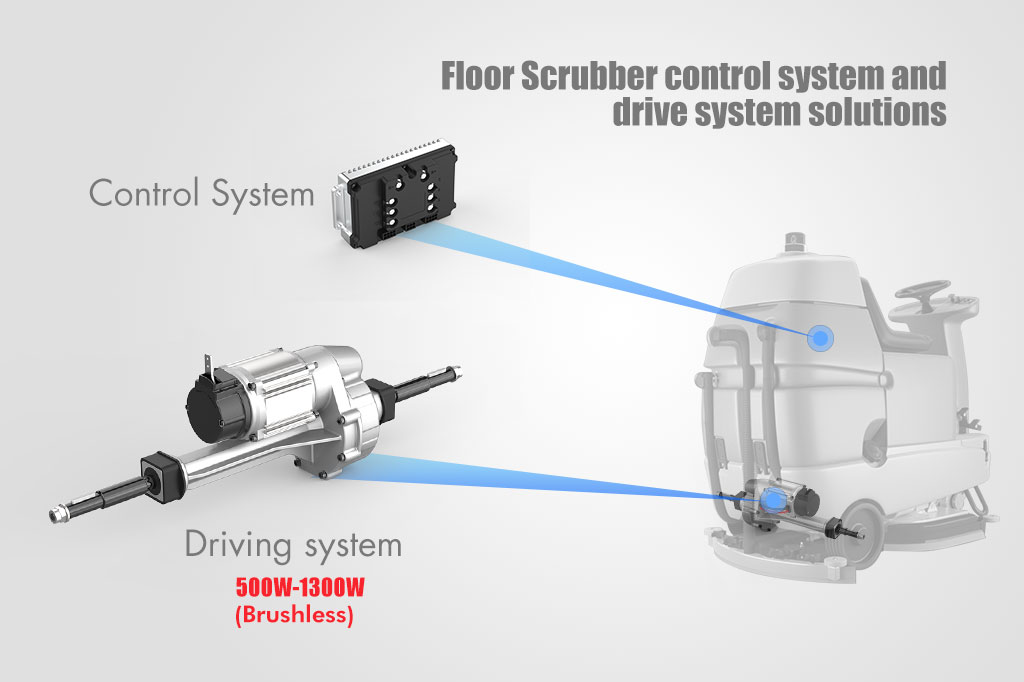 Transaxle for Floor Scrubber
A Practical OEM Selection Checklist
-
- Machine model and maximum loaded weight.
-
- Target travel speed, tire diameter and maximum gradient.
-
- Required continuous and peak wheel torque.
-
- Battery voltage range and available current.
-
- Brushed or brushless motor preference and controller interface.
-
- Axle dimensions, mounting drawing and wheel connection.
-
- Noise target, working environment and duty cycle.
-
- Annual volume, prototype quantity and expected delivery schedule.
Frequently Asked Questions
Is a higher-power drive axle always better for a floor scrubber?
No. Excess power can increase cost, electrical demand and packaging requirements. Select the drive system around the actual load, speed, gradient and duty cycle.
Should a floor scrubber use a brushed or brushless drive motor?
Both can be suitable. Compare lifecycle maintenance, controller requirements, efficiency, cost and service capability for the intended operating hours.
Can the axle be customized for an OEM cleaning machine?
OEM projects may require review of axle length, mounting points, wheel interface, motor voltage, gear ratio, brake and controller configuration. Feasibility should be checked against the vehicle drawing and performance targets.
Discuss Your Floor Cleaning Machine Drive Requirements
Rotontek works with OEMs and equipment manufacturers on electric drive axle and integrated drivetrain solutions. Send your machine specifications, axle drawing and target performance to discuss a suitable configuration. Contact Rotontek for OEM and bulk enquiries.
Estimate Tractive Effort Before Selecting the Axle
A useful selection process starts with the forces the cleaning machine must overcome. These include rolling resistance, the force needed to climb a gradient and the force needed for acceleration. The total vehicle mass should include the operator, batteries, water, cleaning solution and collected debris at the maximum expected operating condition. Designing around an empty machine can lead to poor performance when the tanks are full.
Once the required tractive force is estimated, wheel torque can be approximated by multiplying force at the tire contact patch by the effective wheel radius. The axle and gearbox must deliver the required torque without exceeding motor, controller or thermal limits. Tire diameter matters: a larger tire travels farther per revolution but requires more axle torque for the same tractive force. Validate the calculation with the actual tire, floor surface and gradient data.
Account for Turning, Traction and Braking
Floor scrubbers often make frequent tight turns in aisles and around furniture. Consider the drive layout, wheelbase, steering arrangement and differential behavior when assessing maneuverability. A drive axle that meets straight-line speed requirements may still produce unwanted tire scrub or handling issues if the vehicle geometry is not considered.
Braking should be specified separately from propulsion performance. Define the required service braking, parking or holding function, and emergency stop behavior at the complete-machine level. If an electromagnetic brake is included in a drive package, confirm its intended function and electrical release behavior. Do not assume that a motor controller’s electronic braking feature replaces a mechanically validated vehicle braking system.
Cleaning Environments Create Special Design Requirements
Cleaning machines operate around water, detergents and sometimes corrosive residues. The drive system’s location, connectors, cable glands, seals and exposed metal surfaces should be reviewed against the actual cleaning method. Occasional splash exposure is different from direct washdown or high-pressure cleaning. Specify the required ingress protection level and test conditions instead of assuming that every component in the package has the same rating.
Noise is another system-level issue. Gear mesh, motor electromagnetic characteristics, controller switching, tire material, mounting stiffness and chassis resonance can all contribute. If the machine is intended for hospitals, offices or retail sites, define an acceptable noise target and measurement method. Compare complete assemblies under equivalent load and speed conditions; a motor-only noise figure cannot predict the sound level of the finished scrubber.
How to Prepare a Drive Axle RFQ for a Floor Scrubber
Send the supplier a dimensioned drawing showing axle length, mounting points, wheel interface, available space and ground clearance. Include vehicle weight in empty and fully loaded conditions, tire size, target travel speed, maximum gradient, expected working hours and turning requirements. Electrical information should include battery voltage range, available current, motor preference and the machine controller’s input or communication signals.
Also state the operating environment, cleaning chemicals, water exposure, noise target, brake requirements and annual production volume. Ask for the proposed model code, datasheet, outline drawing, wiring diagram and a clear list of included components. If the supplier proposes more than one configuration, request a comparison showing the assumptions behind each option.
Sample Evaluation: What Should OEMs Test?
During prototype evaluation, test the machine at its maximum operating weight. Check starts on the specified gradient, low-speed control, turning behavior, reverse operation, repeated stop-start cycles and continuous operation over a representative shift. Monitor motor and controller temperature, battery voltage, current draw and any diagnostic faults. Inspect the axle mounting, wheel fasteners, cable routing and connector security after the test.
For cleaning equipment, repeat relevant tests on the intended floor surfaces and after exposure to the normal cleaning process. Document the test conditions and acceptance criteria so that the approved sample can be compared with production units. This creates a more reliable basis for supplier approval than a brief no-load demonstration.