

Propelled by technological advancements and tightening environmental regulations, the lawn mower industry is accelerating rapidly toward electrification. Within this trend, the electric drive system has become increasingly important, as it directly determines the equipment’s peak performance, operational efficiency, battery optimization, and overall service life.
An improper selection can lead to insufficient power, reduced runtime, and may also cause system overheating, premature failure, or even safety hazards. This guide aims to assist in scientifically selecting the most suitable electric drive system for electric lawnmowers.
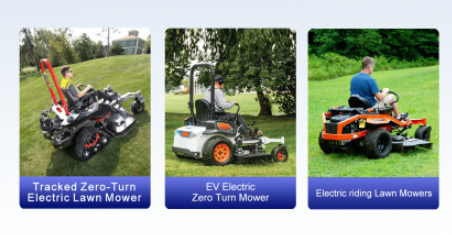
Lawn Mower Equipment Types and Their Drive Requirements
The requirements for an electric drive system can vary across different classification dimensions, primarily defined by equipment scale and application scenarios, locomotion methods, and special operating conditions.
1. Classification by Usage Scenario and Scale
(1) Household/Residential
Residential lawn mowers are typically used for short durations on relatively even ground. Their electric drive systems are expected to deliver smooth motion, predictable speed control, and adequate torque for light grass resistance.
(2) Commercial/Professional Grade
These mowers run for extended periods under sustained load. The electric drive systems must support continuous power output, effective heat dissipation, and long-term reliability without performance degradation.
(3) Robotic Lawn Mowers
Engineered for fully autonomous navigation and mowing, their main requirements are ultra-high efficiency, precise low-speed control, and seamless integration with navigation/sensing systems to optimize path planning and extend operating range per charge.
2. Classification by Locomotion Method
Lawn mower equipment can also be classified by the locomotion methods:
(1) Walk-behind/push Type
Walk-behind mowers require strong torque at low speeds to overcome rolling resistance and grass load during startup and directional changes.
(2) Riding Type
Riding mowers carry higher mechanical loads due to vehicle mass and operator weight. The wheel-drive systems must deliver higher power levels consistently while maintaining electrical stability and operational reliability over long operating cycles.
(3) Zero-turn radius (ZTR) Type
ZTR mowers depend on two independently controlled drive systems. Precise torque balance and rapid response to control inputs are mandatory to achieve accurate turning and stable tracking. Any mismatch in drive response results in uneven motion and reduced control accuracy.
3. Considerations for Special Operating Conditions
(1) Steep Terrains
These environments pose a risk of equipment rollover. The electric drive system needs to feature a robust anti-rollback function, such as electromagnetic braking or software-controlled reverse torque locking.
(2) Wet, Slippery, or Uneven Terrains
To combat traction loss, the drive controller should incorporate traction control logic capable of intelligently adjusting output by detecting wheel speed differentials, preventing wheel spin in muddy areas.
(3) High-obstacle Environments
Frequent starts, stops, and turns call for fast response characteristics. Additionally, system efficiency and thermal management face greater challenges under such operating conditions.
Guide to Quantifying Operational Needs
Selecting an electric drive system becomes far more accurate when measurable technical parameters are prioritized. Here are some important considerations in this regard:
(1) Area/Frequency vs. Power/Runtime
Larger mowing areas and higher usage frequency increase energy demand and runtime requirements. In these cases, continuous power capability and thermal stability matter more than short-term peak power.
(2) Slope/Terrain vs. Torque Requirements
Slope and terrain directly affect torque demand. As the incline increases, the driving system must deliver higher low-speed torque to maintain motion and prevent rollback, especially during starts and stops.
(3) Grass Conditions vs. Continuous Load
Dense or wet grass raises rolling resistance and extends high-load operation. The electric drive systems should be selected with sufficient margin to handle these continuous load increases without overheating or power loss.
Common Selection Mistakes and Maintenance Advice
Avoiding common mistakes and following basic upkeep practices significantly improves performance and service life.
1. Typical Selection Mistakes
(1) Over-prioritizing Peak Power
Selecting motors centered solely on peak power often leads to poor efficiency at real operating speeds, increased heat generation, and unnecessary battery drain. The expected load range is a more critical performance indicator than its maximum power rating.
(2) Ignoring the Impact of Actual Operating Conditions
Many buyers select the electric drive systems for ideal conditions or short-duration test assumptions. It is essential to analyze the actual environment and expected duty cycles to select the most suitable product.
(3) Mismatch of Motor, Battery, and Controller
An imbalance between system components limits output and stability. For example, a high-capacity motor paired with an undersized battery or an overly limited controller creates system-level limitations.
2. Routine Maintenance and Fault Diagnosis
To guarantee long-term performance and lifespan of the electric drive system, implement a routine inspection protocol focusing on electrical connections, cooling paths, and battery health. Common fault symptoms often indicate specific issues:
- Overheating: Typically signals continuous overload or obstructed cooling.
- Abnormal Noise:Usually points to mechanical wear in bearings, gears, or loose components.
- Reduced Power: More often stems from battery capacity fade, poor connections, or controller limitations than from primary motor failure.
Prompt diagnosis and corrective action based on these symptoms are recommended.
Modern Drive System from Rotontek
As a leading manufacturer of specialized motor solutions, our products are engineered to match specific operational demands, ensuring optimal efficiency, durability, and control across all types of lawn care and landscaping applications.
1. Residential & Light-Duty Solutions
Our 500W / 800W Series is best for walk-behind mowers, robotic mowers, and small outdoor power equipment.
- High Efficiency:Optimized for intermittent operation with a focus on low-speed torque and smooth control.
- Low Noise: Adapts to a brushless hub motor design for quiet, residential-friendly performance.
- Low Maintenance:Crafted for stable traction and long-term reliability on uneven terrain with minimal upkeep.
2. Commercial & Heavy-Duty Solutions
ND42 (1000W / 1500W) Series is suitable for Zero-turn radius (ZTR) mowers, riding mowers, and professional mowing platforms.
- Sustained Power:Produces high continuous power and robust torque for heavy loads and long duty cycles.
- Precision Control:Designed for dual-drive configurations requiring high accuracy and responsive handling.
- Industrial Durability:Facilitates a sealed, robust construction to withstand harsh operating conditions.

Conclusion
The right drive system is not merely a component, but the core determinant of efficiency, durability, and total cost of ownership in modern lawn care equipment. From the high-efficiency 500W/800W Series to the robust ND42 Series, Rotontek presents tailored solutions that meet the precise demands of today’s evolving landscaping industry.