
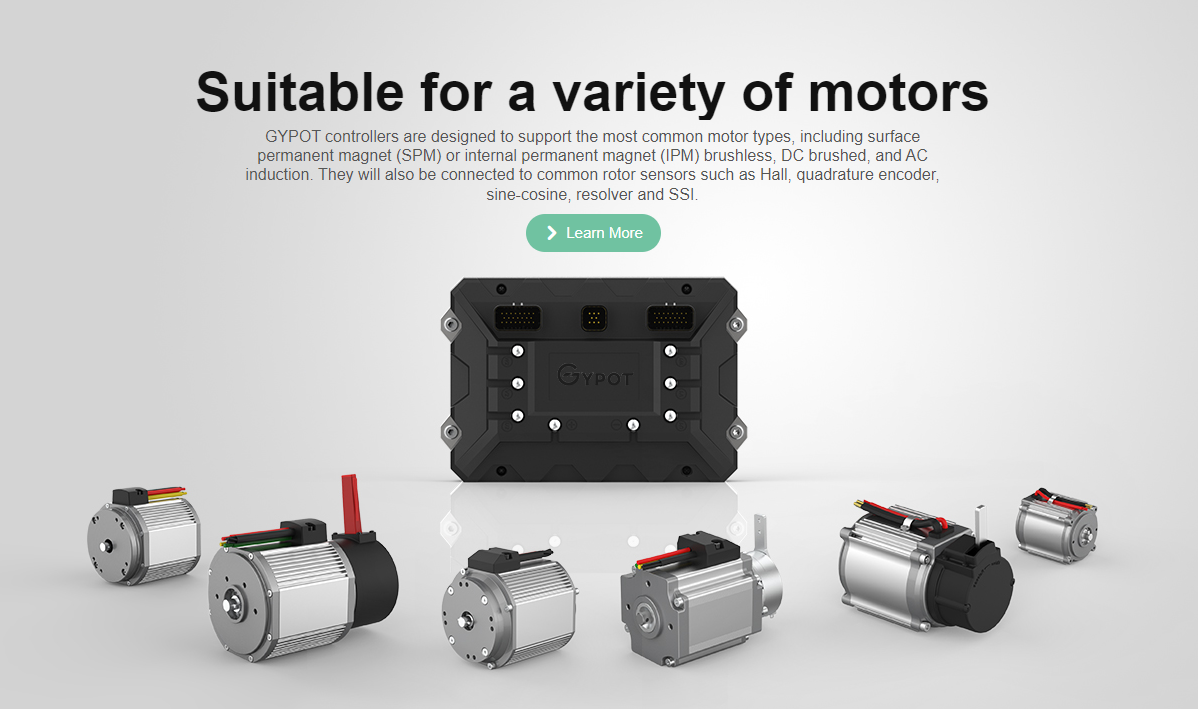
Knowing how a motor controller functions is crucial when designing contemporary electromechanical systems, particularly when combined with a BLDC motor. To accomplish precise position, speed, and torque control in our day-to-day engineering work at Rotontek, we rely on the close integration between a BLDC motor and a motor controller. BLDC motors or servo drives enable mission-critical activities in electric vehicles, drones, industrial robots, and smart medical devices, all of which depend on motor controller technology. As a result, we put a lot of effort into developing cutting-edge motor controller solutions that provide our international OEM partners with dependable, consistent performance.

Understanding the Relationship Between a BLDC Motor and Its Motor Controller
A BLDC motor cannot operate efficiently without a smart, responsive motor controller. Unlike brushed motors, BLDC motors require electronic commutation, real-time feedback, and carefully modulated current to perform well in demanding environments. This is where our engineering team steps in.
At Rotontek, we develop motor controllers that manage speed, start-up behavior, torque output, and direction with incredible accuracy. These systems continuously read Hall sensor signals, convert them into position feedback, and use that information to adjust current timing. Through this closed-loop process, the motor controller ensures a stable, high-performance response from the BLDC motor in electric vehicles, UAVs, manufacturing equipment, and medical devices.
The synergy between the BLDC motor and the motor controller allows our customers to build more efficient machines, reduce noise, and increase productivity.
How a Motor Controller Works: Core Mechanisms and Control Strategies
Our motor controllers use several advanced mechanisms to control BLDC motors with precision. One of the most important is PWM (Pulse Width Modulation). The DC motor controller adjusts the armature voltage through PWM signals operating between 1–20 kHz, ensuring smooth and accurate speed transitions. Combined with Hall sensor closed-loop control, we achieve an impressive ±1% speed regulation accuracy.
For power management, we rely on a MOSFET power module that switches current with up to 98% conversion efficiency, minimizing losses and heat generation. In addition, our control algorithms use real-time PID calibration, allowing a BLDC motor to maintain stable output even under variable load conditions. With this system, users can achieve 0–3000 rpm stepless speed control while reducing energy consumption by 40% compared with traditional resistance-style speed regulation.
(Note: These values are based on actual laboratory measurements.)
This intelligent control process is what enables a motor controller to interact with a BLDC motor so effectively across different industries.
Why Our Motor Controllers Deliver Superior Performance for EVs and Industrial Systems
As a trusted motor controller manufacturer, we specialize in integrated solutions that combine motor speed control, battery management, protection functions, and regenerative braking. Our low-speed motor controllers for electric vehicles regulate powertrain behavior in e-bikes, scooters, compact EVs, AGVs, forklifts, and unmanned vehicles. These controllers protect the motor system, optimize acceleration, and extend battery life—features that are essential in modern mobility platforms.
One of our flagship models, the 24–48V 100A×2 Dual Brushless DC Motor Controller B530H, demonstrates how a high-performance motor controller can transform a BLDC motor system. With CAN-BUS programmability, dual-motor control, and precise calibration features, the B530H is ideal for advanced AGV systems, warehouse robots, industrial forklifts, and heavy-duty unmanned platforms. It supports simultaneous control of two independent BLDC motors, greatly improving efficiency and reducing component count for OEM customers.
Whether our partners need a brushless controller, proportional control unit, or a hybrid configuration, our team guides them toward the ideal solution. Across all projects, we ensure safety, stability, and long-term reliability—core values that define Rotontek engineering.
The Future of BLDC Motor Control Lies in Intelligent Electronics
At Rotontek, we believe that the future of motion control depends on increasingly intelligent motor controller technology. By combining real-time feedback systems, high-efficiency MOSFET power modules, advanced PWM control, and programmable algorithms, a modern motor controller can unlock the true performance of a BLDC motor. As we continue to innovate, our mission remains the same: to deliver smarter, more efficient, and more reliable motor controller solutions for the global manufacturing, automotive, and robotics industries.