

The brushless direct current motor now enters its primary era with the development of intelligence, high performance, low maintenance, and low noise and becomes the first choice in an entire world of industrial applications. According to the data published by Market Research Future, the global BLDC motor market was worth $8.72 billion during the year 2022 and is expected to be worth $16.29 billion by the year 2030, courtesy of the annual average growth of 8.1%. This boom also owes its growing demand to the use of electric vehicles, household appliances, and industrial automation.
In using and maintaining brushless DC motors, the most crucial thing is troubleshooting through which one will guarantee motors’ service life. Significant differences remain between different types and models of brushless direct current motor units concerning the electrical systems, sensor and signal causes, and mechanical components. We will discuss a proper electrical inspection, sensor and signal inspection, and mechanical inspection. We explain how to make the right service for your brushless DC motor according to the required parameters in the corresponding differences of various types of motors.
DC Motors Electrical System Diagnostics
Check Power Supply
Before anything else, before troubleshooting, you should check for the right voltage and current values on the motor. It is better to measure the values with a high-quality multimeter. If it is a motor of 24V rating, then this 24V should always be supplied to the motor. Any deviation from this indicates an incorrect work by power supply unit or by the wiring. It must have a good quality cable as loss of voltage through it will be less in good cables. Different motors will require different voltage and current values, you must check on your motor’s datasheet.
Inspect Connections
It may be loose connections or damaged connections which cause sporadic power outage issues or shaky operation. Go ahead and check out all the lines and connectors carefully, looking for broken, corroded, or physically damaged ones. If you see any loose connections, tighten them or replace damaged wires. You could also remove corrosion quickly with an electrical contact cleaner at this time. The part of a brushless motor that will not give you problems is going to be bought from a top-quality brand supplier such as Rotontek.
Test Controllers
In order for DC brushless motors to work well, they are provided with motor controllers. The controller will be considered faulty if, through the diagnostic tools, you have confirmed that there are no error codes or bad control signal irregularities. A defective controller will show symptoms in the way of sharp speed variations or the controller will not start at all. Another means that can be used is to plugin a verified good controller to check if the fault comes from the controller or not. The fact is that sometimes the firmware was outdated, so we can solve it by updating. The control is never so 100% reliable, so the problem might sometimes be a result of the specific motor model.
DC Motors Sensor and Signal Evaluation
Hall Sensor Check
Detection of the rotor location is one of the main functions of Hall effect sensors in the operation of any motor. Turning the motor manually tests each sensor and notes the outputs of each sensor. Each sensor should provide a clean periodic signal. The integrity of the waveform can also be verified on the oscilloscope. If a sensor fails as it should, it could be defective; replace it. Always ensure that the sensor alignment and connections are in place. More expensive motor types will use better quality/reliability sensors.
Signal Integrity
Wear and EMI investigation of signal cable. Shielded cable reduces noise and thus provides clearer signals. Poor condition signals will cause miscommunication with the motor and controller which result in erratic motor functioning. Check the nearby EMI sources and relocate or shield them. Check the security of all signal connections. Different motor models will have different susceptibilities to EMI, and this should be taken into account.
DC Motors Mechanical Inspection
Physical Damage
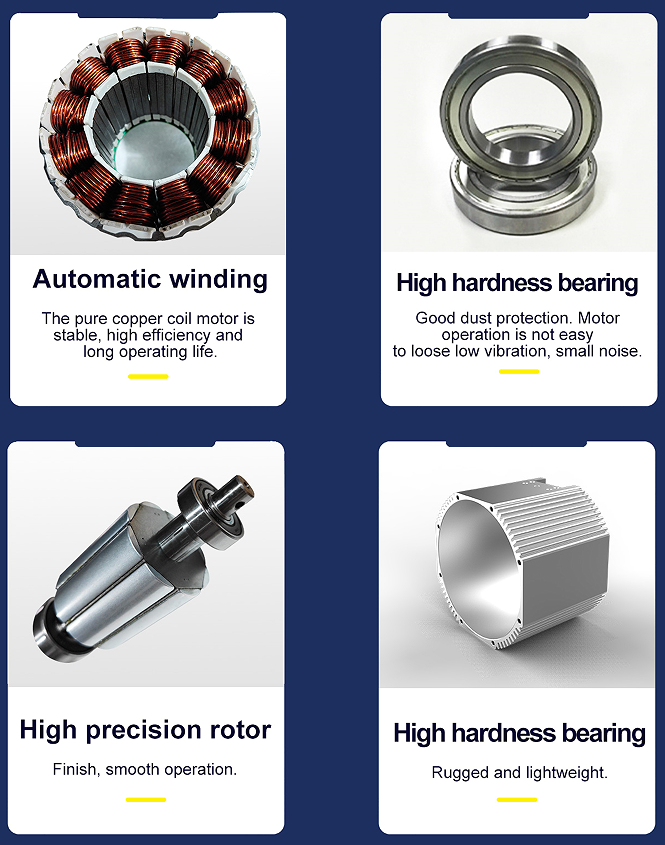
It is not necessary to dismantle your engine to know the condition of your engine-the exterior has much to say about it. The most important things to look for are severe cracks, dents, or damage that is visible and reduces the effectiveness of the motor. The other point is to make sure that it is firmly mounted and does not have any blockage in its cooling vents. Since most of the time damage occurs physically, also consider motors with heavy-duty exteriors, which rarely have cracks, dents, or other visible marks, to augments application considerations.
Bearing Condition
Turn the engines motor shaft by hand and listen for odd, squeaky noises. The bearings should normally turn without struggling, and they make no sound. The bearings are grinding or rolling unevenly, indicating the need for lubrication or replacement with the same quality grease as specified by the motor’s manufacturer. Ensure that bearing is not over-lubricated since it attracts dust and other debris, which are detrimental to its life expectancy. Safety and reliability of bearings differ considerably in different motor types.
Noise Analysis
Motor testing involves spinning the motor and listening for abnormal noises like whining, clicking, and grinding. Such noises may signify mechanical problems including worn bearings and misaligned mechanical parts. A look at the rotor and stator surfaces will tell if there has been any physical contact or signs of wear. Different manufacturers make different noise levels and mechanics of faults in motors. Therefore it is possible to know what the problem might be by comparing the two.
Factors to Consider for Different Motor Models
In troubleshooting brushless DC motors, you must apply different models of motors. Ideally, buy them from a giant and trusted name like Rotontek. They manufacture extremely high-efficient, noise-free brushless motors having a very long service life, specifically engineered for automation needs. At the same time, you can save most of the costs. An electric and mechanical reliability as well as even whole motor performance vary to a very great extent between different manufacturers, and some of the value points worth evaluating include:
Different motors may demand different levels of voltage and current. Ensure that the appropriate supply matches every model. Some motors must work with other controllers that are supposed to use specific motor performance features to their best. Thus, the controllers should always be checked when working with such motors.
Bearings from various producers really impact the longevity of a motor, especially those bearings that are of higher class with no extra attention to servicing, while the housing should also be such that it holds the parts of the machine from getting dust, dampness, and physical impact.
The quality as well as the location of the Hall effect sensor; with a better quality sensor, it is attached less failure modes, and further provides a more accurate estimation of motor position- they will also be beneficial in its performance. It can be relative noise as well, which is produced by different models of motors and should be considered while purchasing one for applications where sound generation is not desirable.
The motor can be everything made of easily accessible components like bearings and Hall effect sensors. At the same time, components should not wear out rapidly to be replaced. That way, should any of the motor components fail, it can be easily and timely replaced with a reserve.


