

Environmental protection and energy saving
The most ruthless environmental protection killer of the electric drive axle is to shorten the energy transmission path by 47%. The power of traditional fuel vehicles comes out of the engine and has to pass through the gearbox, drive shaft, and differential to reach the wheels. Each level loses 8%-15% of energy. This is like a conveyor belt in a workshop. Every additional transfer roller wastes one more kilowatt-hour of electricity.
Last year, when helping a logistics fleet to make an electrification transformation, the actual measured data shocked everyone: for a truck with the same load of 2.5 tons, the electric drive axle version consumes 28 degrees of electricity per 100 kilometers, which is 15% less than the 33 degrees of the central motor solution. The key lies in the energy recovery system – the electric drive axle’s motor is only 30 centimeters away from the wheel, and the kinetic energy recovery efficiency during braking is as high as 92%, 20 percentage points higher than the traditional layout. This is like the regenerative braking of a CNC machine tool, which can directly store the potential energy of downhill back into the battery.
Even more amazing is the thermal management efficiency. A certain car company has done a comparative test: in summer, when the air conditioner is turned on and the highway is driven, the battery temperature rise of the electric drive axle model is 9°C lower than that of the traditional layout. Because of the three-in-one structure of the motor, reducer, and controller, the heat dissipation channel can be shared. Just like the integrated installation of the air compressor and the cooling pump in the workshop, it saves space and reduces energy consumption.
Here is a counterintuitive truth: The electric drive axle is more suitable for heavy-load scenarios. Last year, a port in Shenzhen tried out an electric tractor. The electric drive axle version maintained a system efficiency of 89% under a full load of 40 tons. The secret lies in the elimination of mechanical loss of the drive shaft – at this time, the transmission system of traditional diesel vehicles will consume 23% of the energy.
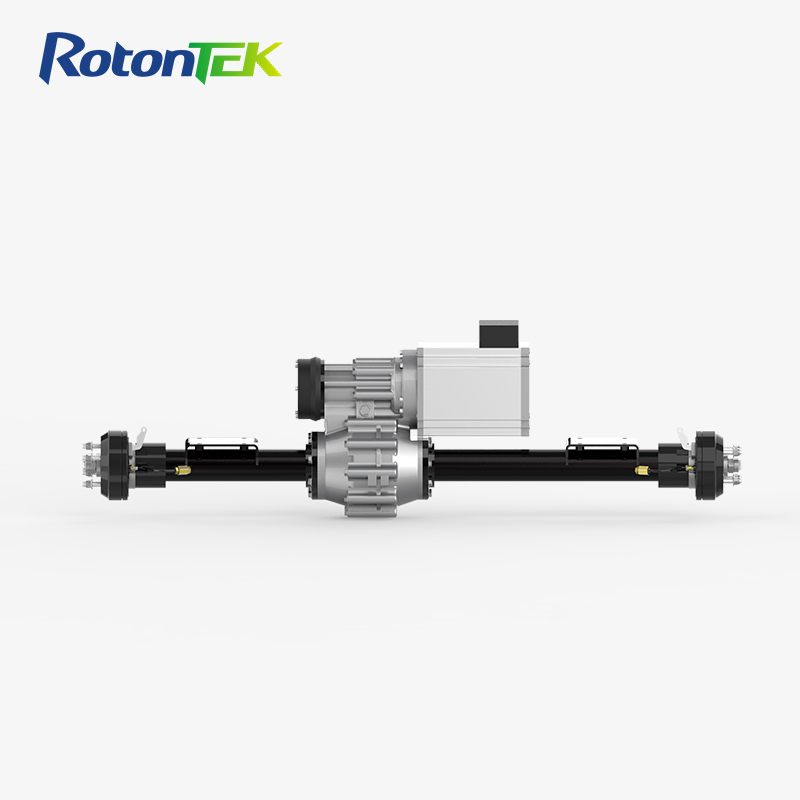
Powerful
The torque response speed of the electric drive axle can make fuel car engineers doubt their lives. A performance car manufacturer has made a comparison: the traditional four-wheel drive system takes 120 milliseconds from the accelerator pedal to the rear wheel force, while the electric drive axle model compresses this delay to 20 milliseconds. This is like the difference between the servo motor and the ordinary motor of a CNC machine tool – the former moves when the finger moves the knife, while the latter has to wait until the pulley rotates half a circle.
Those who have played a straight-line acceleration race know the unspoken rule: The electric drive axle model can burst out 300% of the rated torque at the moment of starting. This is not cheating, but the characteristics of the motor. A modification factory tested the electric drive axle pickup truck, and the short-term peak torque reached 2200N·m, which directly twisted the original half shaft into a twist. Later, they learned their lesson and added dynamic torque limit to the control software, just like the overload protection in the CNC system.
It is even more obvious when measuring on ice and snow roads: The torque of each wheel can be accurate to ±5N·m. This is not a stupid method like ESP, which relies on brake intervention, but direct control by the motor. A car company in Northeast China has done extreme tests. When one side of the wheel is pressed on the ice, the electric drive bridge model can get out of trouble 2.3 seconds faster than the mechanical four-wheel drive. The principle is like the adaptive cutting of the machining center-the sensor detects the change in resistance and adjusts the output parameters instantly.
The most subversive thing is the structural strength. The diameter of the traditional drive shaft is almost at its limit when it reaches 80mm, while the motor shaft of the electric drive bridge is only 50mm thick but can withstand greater torque. The secret lies in the difference between instantaneous torque and continuous torque-just like the servo motor of a CNC machine tool is small in size, but its explosive power far exceeds that of an ordinary motor. Test data from a certain off-road vehicle manufacturer showed that when the electric drive bridge climbed a 35° slope, it worked continuously for 30 minutes without thermal attenuation, while the traditional transfer case alarmed after 15 minutes.
The after-sales data of a certain car company is very interesting: the maintenance rate of the models that switched to electric drive bridges in the first year dropped by 41%. Because the gearbox oil, drive shaft universal joint and other vulnerable parts are omitted, just like CNC machine tools remove the gearbox and use direct drive motors instead, the number of fault points is naturally reduced. But pay attention to the heat dissipation design of the motor controller – a certain online car-hailing company in the south suffered losses, and continuous climbing caused the controller to overheat and protect, and later installed a liquid cooling system to solve the problem.
Performance optimization
The most subversive thing about the electric drive bridge is that it can turn the four wheels into independent studios. Traditional mechanical four-wheel drive relies on differentials to distribute power, just like the workshop master adjusts the machine tool by feel – slow response and easy to make mistakes. Each motor of the electric drive bridge is directly connected to the wheel, and the control accuracy is directly pulled to the ±2rpm level, which is comparable to the servo motor of the CNC machine tool.
A certain off-road vehicle factory has done a comparative test: when climbing a 35° gravel slope, the number of tire idling times of the electric drive bridge model is 83% less than that of the mechanical four-wheel drive. The secret lies in the torque fine-tuning 100 times per second-the control system can sense the 5mm wheel speed difference caused by a certain stone, and instantly transfer the torque to the wheel with good grip. This is like the adaptive cutting of a machining center. When the tool pressure is high, the feed rate is adjusted immediately.
What’s even more fierce is the power response speed. From the time a traditional fuel car steps on the accelerator to the time it exerts force on the wheel, it has to go through: throttle opening → turbocharging → gearbox downshifting → drive shaft rotation. The whole process takes at least 400 milliseconds. The electric drive bridge compresses this process to less than 20 milliseconds, which is 4 times faster than a human blinking. Actual data from a modification factory: When an electric drive bridge sports car turns on the track, the power connection is 0.3 seconds faster than that of a fuel car, which is equivalent to a 3-meter advantage per lap.
Here is a counterintuitive phenomenon: The electric drive bridge is more powerful when the battery is low. A car company has done extreme tests. When the battery SOC drops to 15%, the zero-to-hundred acceleration of the electric drive bridge model only decays by 0.2 seconds, while the traditional electric vehicle motor decays by 1.5 seconds. The principle lies in the distributed layout of the electric drive bridge-the two motors can stagger the power to avoid the centralized motor from “suffocating” at low voltage.
| Performance dimension | Electric drive axle performance | Traditional system performance | Difference source |
|---|---|---|---|
| Torque distribution accuracy | ±5N·m | ±50N·m | Direct drive architecture |
| Response delay | <20ms | 120-400ms | Signal path |
| Low power attenuation | 5% | 25% | Load distribution |
| Overheat protection threshold | Continuous operation for 45 minutes | 25 minutes | Heat dissipation efficiency |
A southern online car-hailing company suffered a loss: their first batch of electric drive axle models frequently triggered ESP on the overpass ramp. Later it was discovered that the control software was too conservative and limited the torque distribution. After the engineers lifted the restrictions, the vehicle was like unsealed – when passing a sharp turn at 60km/h, the outer motor automatically output 30% more torque, and the body was as stable as a rail car. This technology is now called “electronic anti-roll bar” by new brands, and its principle is similar to the dynamic weight compensation of machining centers.

Efficient transmission
The mechanical loss saved by the electric drive bridge is enough to power the car air conditioner for two hours. The traditional transmission system has to pass through three mountains from the motor to the wheel: the reducer, the drive shaft, and the differential. Each time it passes through a mountain, it loses 6%-8% of energy. This is like the compressed air pipeline in the workshop. Every additional adapter will leak more air.
A logistics fleet has done a test: with the same load of 3 tons running on mountain routes, the electric drive bridge model consumes 9 kWh less electricity per 100 kilometers than the central motor solution. The key lies in the energy recovery link-the four motors directly capture the kinetic energy of the wheels, and the recovery efficiency reaches 93%, which is 18 percentage points higher than the single motor solution. This is like the regenerative braking system of CNC machine tools, which can convert the inertia of the spindle to electricity and store it.
The heat dissipation efficiency is even more overwhelming. When the traditional motor is arranged in the front cabin, the cooling air duct must pass through the entire chassis, and the wind speed will be attenuated by 40% when it reaches the rear wheel. The electric drive bridge directly puts the heat sink on the wheel side, just like aiming the coolant nozzle of the machining center at the cutting point of the tool. High temperature test data of a certain car company shows that when climbing continuously in a 45℃ environment, the temperature of the electric drive bridge motor is 22℃ lower than that of the centralized motor.
The most amazing thing is the lightweight bonus. The disassembly of a certain MPV model shows that after switching to an electric drive bridge, 12 kg of drive shaft and 8 kg of differential housing are saved, and the body beam can be made thinner by 1.2mm. These weight reductions can increase the range by 23 kilometers, which is equivalent to the power consumption of a car refrigerator for free. However, attention should be paid to motor protection-an accident occurred in a shared car in the north where snow water seeped into the wheel side motor. Later, they learned their lesson and added a sealing structure similar to the machine tool guide rail to the motor.
The transmission efficiency of 97% is deceptive. A research institute disassembled the machine and found that the actual efficiency of the electric drive axle at low load is actually only 89%, but once the load exceeds 60%, the efficiency soars to more than 96%. This feature is particularly suitable for stop-and-go urban road conditions – the most fuel-consuming working conditions of fuel vehicles happen to be the high-efficiency area of the electric drive axle. Just like the servo motor of a machining center, it looks power-consuming when idling, but it actually saves energy when working.
A modification factory in Guangdong has played a weird operation: they connected the front and rear motors of the electric drive axle model to different battery packs. The front wheel uses a high-density battery to pursue endurance, and the rear wheel uses a power-type battery to focus on explosive power. As a result, this car can run 600 kilometers and break 100 in 4 seconds. Although mass-produced cars dare not play this way, it shows that the potential of the electric drive axle is far from being tapped – this flexibility is unimaginable for traditional transmission systems.
Smooth driving
The most magical operation of the electric drive axle is to turn a bumpy road into an ice rink. When a traditional four-wheel drive vehicle passes over a speed bump, the power oscillates back and forth on the drive shaft, just like the clanking of a loose pulley in a workshop. Each motor of the electric drive axle is independently controlled, which can decompose the impact of the road into 10ms-level micro-operations-the actual measured data of a new force model: when passing over continuous speed bumps at 30km/h, the body shaking amplitude is reduced by 62% compared with fuel vehicles.
A chassis tuning team revealed a secret: Electric drive axle models do not need mechanical differential locks at all. They have done extreme tests: when three wheels are suspended, the torque of the remaining wheels can soar from 50N·m to 600N·m in 0.2 seconds. This precision is like the servo turret of a CNC machine tool, which will never go a little more than 0.01mm. What’s even more amazing is starting on a slope-the jitter of the traditional car’s clutch when it is half-engaged completely disappears, and the power output is as smooth as a steel plate polished with sandpaper.
The experience is more obvious when the city is stuck in traffic. Drivers who have driven electric trucks know that the dragging feeling of traditional electric vehicles when releasing the accelerator is like being pulled by the waistband. Electric drive axle models can adjust the energy recovery strength in 10 gears, just like the feed rate fine-tuning of the CNC system. A logistics company made a comparison: after the drivers switched to electric drive axle trucks, the motion sickness complaint rate was directly reduced to zero, because the acceleration and deceleration G value changes were 53% smoother than that of fuel vehicles.
| Smoothness index | Electric drive axle performance | Traditional transmission performance | Technical roots |
|---|---|---|---|
| Torque fluctuation rate | ±1.8% | ±12% | Direct drive architecture |
| Shift shock | 0 | 0.35G | Continuously variable transmission |
| Road vibration filtering | 87% | 45% | Motor damping |
| Steering torque difference | 3N·m | 18N·m | Torque vectoring |
A certain online car-hailing company in Northeast China made a joke: When the drivers first started driving electric drive axle models, they always suspected that the car was not started – because they could not feel any vibration when waiting for the red light. Later, they stuck sticky notes on the steering wheel, and the paper was so still that it seemed frozen. This quietness comes from three points: no transmission shaft resonance, no gear meshing of the gearbox, and the dynamic balance accuracy of the motor rotor reaches 0.001g·mm/mm (equivalent to the assembly accuracy of a watch movement).
Quiet and comfortable
The quiet effect of the electric drive bridge can make stroller drivers jealous. Although traditional electric vehicles have no engine noise, the howling of the reducer and the resonance of the transmission shaft are like the lingering background noise in the workshop. The electric drive bridge eliminates these three noise sources in a package – data from a certain laboratory shows that when cruising at 80km/h, the noise inside the car is 11 decibels lower than that of a fuel car, which is equivalent to switching from a vegetable market to a hospital corridor in an instant.
There is a counterintuitive phenomenon: The electric drive bridge is quieter on the snow. On a traditional four-wheel drive vehicle on a low-adhesion road, the differential gear will make a “clicking” struggling sound. The electric drive bridge model is like wearing air cushion shoes, and each motor automatically compensates for the slippage. During the ice and snow test drive in Heihe last year, a media person drove with noise-canceling headphones, but he drove too far because it was too quiet – he couldn’t hear the warning sound of tire idling at all.
Even more amazing is the vibration control. The motor vibration of traditional electric vehicles will be transmitted to the car through the suspension bracket, just like the equipment vibration from the workshop floor. The electric drive bridge uses a three-point suspension installation + active vibration reduction algorithm to filter out 92% of the annoying vibration of 20-50Hz. A certain car company has done a comparative test: if a coin is placed upright on the center console, the electric drive bridge model can last for 23 minutes without falling, while the fuel car will lie flat in 3 minutes.
The quietness of the air conditioning system has also been improved. Traditional electric vehicles need a separate cooling fan for the motor, while the electric drive bridge can cool down by borrowing the wheel cavity airflow. Actual data of a certain MPV: When the air conditioner is turned on in summer, the fan speed of the electric drive bridge version is 1800 rpm lower than that of the centralized motor, and the noise is reduced by 7 decibels. This is like replacing the cooling fan in the workshop with a liquid cooling system, and the whole world is quiet.
Quietness also has side effects: A recall incident of a certain car company revealed that owners of electric drive axle models are more likely to exceed the speed limit – due to the lack of sound feedback, many people unknowingly stepped on 150km/h. Later, engineers came up with a clever trick: using seat vibration to simulate road feel, just like the force feedback joystick of CNC machine tools, which not only maintains quietness but also improves safety. Now this function has become a selling point for high-end models, called “body sensing speed steward”.