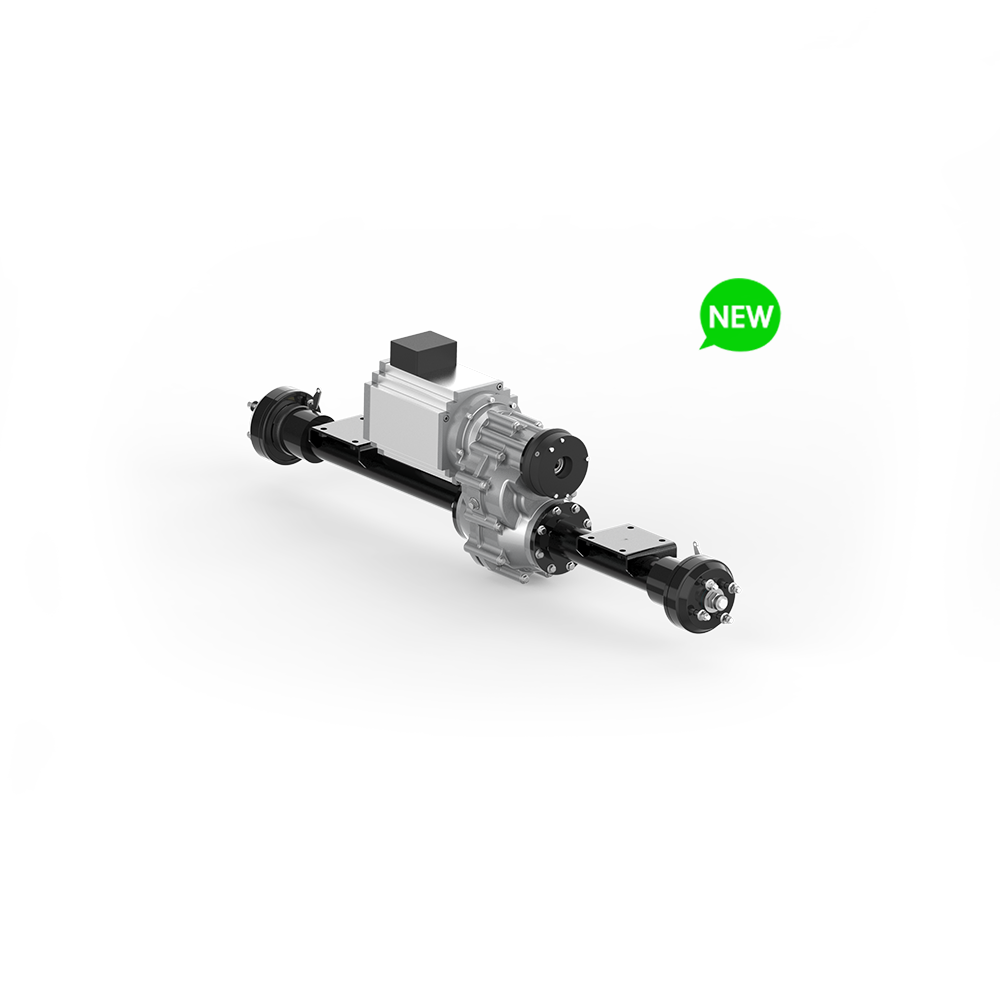
Some of the key technologies driving the development of electric drive axles include low-noise design (reduced gear noise by 30%), high-precision manufacturing (component processing accuracy controlled within 0.01 mm), advanced material applications (noise reduced by 12%), and precision assembly technology (total vibration level reduced below 0.5 g) that significantly improve performance and durability.
Low-Noise Design
Low-noise design is among the targets in the development of electric drive axle technology. Noise not only influences the driving comfort of a vehicle but also causes extra vibration and abrasion, which will reduce the durability of the whole vehicle. Basically, noise reduction in electric drive axles is accomplished by the following approaches:
Optimization of gear design. Noise and vibration produced during the meshing of gears are mainly caused by meshing errors and surface roughness. To reduce these errors, advanced fine grinding processes are implemented at Rotontek, which, besides making gear meshing smooth, also result in less friction noise, hence quieter operation. It is possible to reduce noise by up to 30% for gears treated with fine grinding processes, which is rather hard to achieve with normal ones.

Gears are made from high-strength forged alloy steel. This material has a more homogeneous internal structure and better resistance to fatigue. Compared to general cast gears, forged alloy steel gears reduce noise that may result from stress concentration during gear running and meshing. From various comparative tests, it was shown that the noise intensity for forged alloy steel gears was around 15% lower than that of ordinary cast steel gears.
In the gearbox design, composite soundproof materials are applied—usually filled inside the gearbox to effectively absorb the high-frequency noise produced during gear meshing. Moreover, by implementing a double-layer housing structure internally and externally to isolate vibration and noise, a double-layer soundproof design can be realized, which can further reduce noise transmission. Noise can be reduced by 5–7 dB with this structural design.
Lubrication optimization was also implemented in the electric drive axle. Conventional lubricants tend to result in more noise and vibration under high-temperature and heavy-load conditions. A special high-viscosity synthetic lubricant is adopted that can form a thick oil film on the surface of the gear, thus reducing noise to some extent. Noise-reducing additives contained in this lubricant absorb micro-vibration energy caused by gear meshing, further reducing noise. Experiments confirm that this special lubricant provides an additional reduction of about 10% in noise level.
High-Precision Manufacturing
Electric drive axles need high-precision manufacturing to enable them to work stably in such harsh conditions. The precision of gear manufacturing directly influences its meshing quality. With high surface roughness of gears or poor geometric shape precision, the transmission might be accompanied by strong vibration and noise, which even leads to mechanical failure.

In processing the gears, five-axis CNC machining technology is adopted, improving precision in gear machining to the micron level. By numerical control, the surface waviness and the radial runout of the treated gears are controlled within 0.01 mm. Through such a precision-manufactured method, it can be guaranteed that the gears mesh without interference and noise caused by inconsistency of the surface. High-precision machining increases the wear resistance and fatigue life of the gears, maintaining the best working condition even after a very long period of work.
Apart from precision machining of gears, automated assembly can minimize errors caused by manual operation, ensuring the precision of assembly for each component. In particular, in the assembly process of the electric drive axle, it is possible to measure and calibrate the real-time gear pair meshing clearance by adopting the use of an automatic assembly line. Accurately controlling the meshing clearance ensures that there will not be an excessive gap or too tight contact of gears during transmission; hence, it reduces wear and noise.
Advanced Materials Science to Suppress Noise
Advances in materials science open up new approaches in noise suppression of electric drive axles, fundamentally suppressing noise and improving overall performance by selecting better materials.
High-strength forged alloy steel is chosen for the gear material. Compared to the traditional cast steel material, it has much higher strength and is more resistant to wear. The process of forging can remove micro-defects inside the material; therefore, gears can bear high loads without fatigue cracks or deformation, which could result in the loss of gear precision. According to studies, using forged alloy steel gears, electric drive axles can extend the service life by 30% and reduce noise levels by about 12%.
In addition, electric drive axles employ composite sound-absorbing materials. Conventionally, such composite sound-absorbing materials have been used in aerospace and high-performance automotive applications since, apart from absorption of high-frequency noise, they prevent vibration transmission. By their placement within the housing, these composite sound-absorbing materials can attain internal noise suppression of up to 5–7 dB in electric drive axles.

Precision Assembly Technology Control

Precision assembly technology is also critical in electric drive axles for achieving their optimal operating mode. Any small mistake in assembling will affect the general performance of an electric drive axle. During assembling, the process is done at a constant temperature. Assembly under a constant temperature can avoid heat expansion and contraction caused by temperature differences so that each component always stays in an optimally sized state at the time of assembly. This can control assembly errors within 0.005 mm, significantly improving the precision of assembly.
A digital torque wrench is used in assembling to precisely control the tightening torque for every bolt. This can guarantee that each bolt is tightened to the same torque and avoid problems such as housing deformation or vibration noise caused by different torques. Laser alignment technology is used for aligning all rotating parts, making sure alignment precision between the motor and gearbox reaches 0.01 mm. It is this alignment accuracy that can greatly reduce the vibration and noise caused by axis misalignment, hence improving general stability and durability for the system.