

In the world of electric vehicles, AGVs, forklifts, and industrial mobility machines, the VCU is inseparable from the motor controller, because both work together as the central intelligence of the drivetrain. In fact, every smart system we build relies on the tight coordination between the motor controller and the vehicle control unit to deliver smooth acceleration, safe operation, and energy-efficient performance. By integrating these two components, we ensure our customers receive reliable, long-lasting powertrain solutions engineered for professional applications.
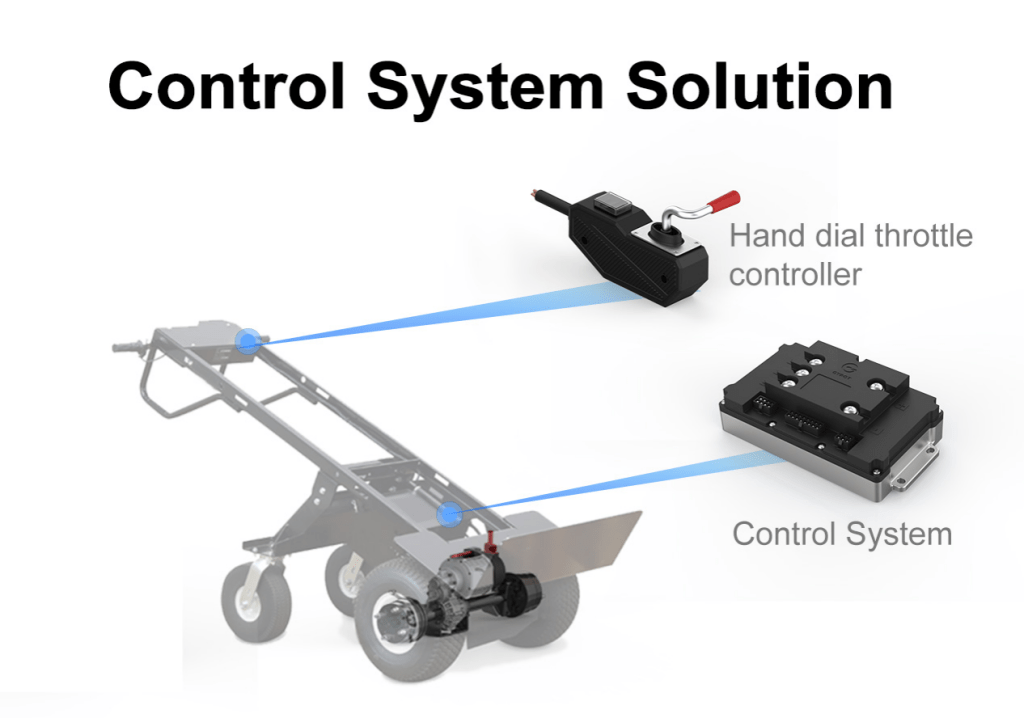
The VCU is the Decision-Making Hub of the Entire Powertrain
To understand the purpose of a vehicle control unit, we start by looking at how many tasks it manages simultaneously. The VCU acts as the command center, constantly processing data from sensors, the battery system, and the motor controller. It then translates this information into precise coordination signals that determine how the vehicle behaves in real time.
For us at Rotontek, the VCU must always be in sync with the motor controller to ensure smooth traction, responsive speed changes, and stable torque output. Whether the system is powering a warehouse AGV or a passenger-oriented mobility device, the vehicle control unit oversees:
- Torque command calculation
- Speed request interpretation
- Safety-state verification
- Battery protection and thermal management
- Communication across CAN-BUS networks
- Synchronization with the motor controller for efficient drive control
This is why we refer to the VCU as the “brain” of the electric vehicle. It dictates operational precision and ensures that the motor controller receives accurate, timely instructions for motor control.
The VCU’s Core Responsibilities and Why They Matter
When our engineering team develops a vehicle control unit, we focus on its ability to manage energy, safety, and real-time decision-making. These responsibilities directly influence how well the vehicle performs and how long its critical components last.
One of the most important relationships in any electric drive system is the partnership between the motor controller and the vehicle control unit. The motor controller handles the direct output—motor speed, motor torque, current, and switching sequences. The VCU, on the other hand, decides what the motor controller should do, based on the vehicle’s environment and user input.
How the VCU Drives Efficiency and Versatility for Professional Applications
One of the biggest purposes of a modern vehicle control unit is to transform efficiency. Our VCU incorporates advanced battery management that optimizes when and how the battery releases energy. At the same time, its energy recovery algorithms allow the system to collect power during braking or deceleration—significantly extending runtime and reducing overall operational costs.
Because we work closely with industries ranging from logistics to consumer mobility, our vehicle control unit must adapt to many environments. This is also why we design motor controller solutions for specialized needs, such as:
- Golf cart motor controller systems
- Forklift motor controller units for precise load handling
- AGV motor controller solutions for continuous autonomous operation
Each application requires unique torque curves, braking logic, and control sensitivity. With our engineering experience, we tune the VCU and motor controller combination to deliver the exact performance our clients need.
Our product philosophy is simple: the more intelligent the VCU is, the more flexible and reliable the motor controller becomes. And when those two elements work harmoniously, the entire electric vehicle experiences smoother control, better lifespan, and lower cost of ownership.
The VCU Defines the Intelligence and Efficiency of Every Electric Vehicle
In modern electric mobility design, the true purpose of a vehicle control unit is to function as the core intelligence behind the system—managing communication, power distribution, safety strategies, and coordination with the motor controller. At Rotontek, we engineer both components with deep integration so our partners benefit from smarter energy use, longer equipment lifespan, and highly stable performance. By choosing advanced VCU and motor controller solutions from Rotontek, our clients invest in the reliability, intelligence, and operational efficiency needed to power the next generation of electric vehicles.