
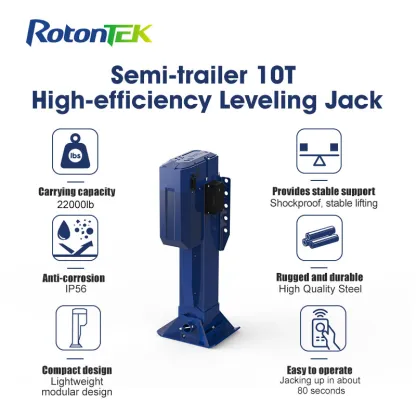
Just as electric parking brakes are better than foot-operated ones, the same is true for leveler jacks. Electric jacks can complete the leveling operation in 5-10 seconds, while manual jacks generally require 1 to 2 minutes to achieve. The efficiency gained amounts to as much as an improvement of nearly hour-percent on this process alone. The electric jacks also come with an intelligent control system that allows automatic high-precision adjustment; leveling error does not exceed ±1 millimeter. Manual jacks are generally controlled manually or by hydraulic means, and the precision of manual jacks level is around ±5 mm. Also, electric jacks get less physically draining which makes them ideal for usage multiple times to level.
Advantages of Electric Leveling Jacks
In present transportation and heavy machines, electric leveling jacks have noticeable technological advantages. An electric jack to level the RV in 5-10 seconds, vs. a manual crank, may take as long as 1-2 minutes. The resulting speed difference means an electric jack can get 80 percent of the time it takes to level during big semi-trailer loading operations. In a semi-trailer loading process, an electric jack reduces leveling from 120 seconds to just on and off in as little as 24 work efficiency times.
The manual jack has a precision of ±5 millimeters, and the electric jack is equipped with an intelligent control system to make it capable of making high-precision adjustments as low+1 mm. This precision advantage is especially useful in trucks that need their body level set regularly. For example, a manual jack error of ±5 millimeters may cause the vehicle to wobble on an undulating highway or uneven ground and pose safety risks, and electric jacks can achieve greater precision for more stability between vehicles at up to±1mm in height.
Technological Advancements in Electric Leveling Jacks
Many innovations in technology with modern electric leveling jacks have made improvements to their abilities and strengths. The electric jacks of today use 1500-watt motors and intelligent control systems, so the process is more automated than when you were doing this task on your driveway. Some jacks, for example, electric ones, can adjust the height by 10 centimeters in a maximum of 10 seconds, while traditional manual would need up to half a minute. The high output motor in the electric jacks allows for large height changes within a short time, which makes working much faster.
Several modern electric jacks can use inbuilt sensors which factor-in the soil conditions to provide real-time feedback, allowing automatic adjustment of operating parameters to optimize leveling effects. So, if an electric jack detects a 10-kilogram or more load deviation, the system will, vice versa, correct itself to keep balance. Electric jacks also have overload protection, fault detection and auto-correction. The device is automatically stopped when the load exceeds 50kg to prevent damage or security risks. All these technological advancements help electric jacks stay robust for stability at high loads and harsh environments.

Application Scenarios of Electric Leveling Jacks
In the truck and semi-trailer sector, electric leveling jacks work especially effectively. Electric jacks can drastically increase work efficiency by performing height adjustments in just 30 seconds during truck loading and unloading processes. Electric jacks can cut the time for adjustment from 120.00 to only 30.00, so it is possible to improve productivity by 75%. This efficient conformation helps in keeping cargo stable and reduces the risk of vehicle leaning.
In all long-distance transportation and busy loading and unloading scenes, the automation/ intelligence of electric jacks can improve work efficiency by 20%-30%. The fast adjustment of electric jacks is conducive to transport security, avoids inaccurate leveling in loading and unloading construction work, effectively safeguards the operator’s health and safety and accelerates delivery rate. The ability to make these adjustments fast significantly increases operational efficiency, which leads, in turn, to smoother transport operations and lower operating costs.

Use gap comparison
Rotontek electric leveling jack reviews, from the user’s point of view, are mostly good, and users appreciate how simple this thing is to use and recalibration precision. Electric jacks work a lot faster than manual ones, thus saving you the hassle of having to go through many more tedious steps. Using an electric jack, operators usually require less than 10 adjustment steps, but with a manual jack over 20, This makes everything simpler and minimizes the level of physical effort needed.
The intelligent control system of the electric jack makes the operation process more intuitive and can also reduce errors caused by manual operation. Electric jacks automatically correct errors to ±1 millimeter; manual jacks wait for us the results may range from +5 millimeters. Intelligent control system operation: More accurate and responsive than manual, thus eliminating safety hazards caused by unskillful hand-held operations. Electric jacks can lead to a 40% mitigation in accidents due to human error, which ensures increased user safety and experience. Especially in terms of operational convenience and adjustment precision, Rotontek’s electric leveling jacks score an intelligent system that supports your efficient completion.
| Feature | Electric Leveling Jacks | Manual Leveling Jacks |
|---|---|---|
| Adjustment Speed | Fast, completes leveling in a short time | Slow, adjustment process takes time |
| Adjustment Precision | High precision, smart control system ensures consistency | Lower precision, dependent on operator skill |
| Operation Intensity | Low, requires minimal physical effort | High, involves significant physical labor |
| Technological Advancements | Equipped with real-time feedback systems and various protection features | Technology is relatively outdated, lacks real-time feedback |
| Application Scenarios | Mainly used for truck and semi-trailer leveling tasks | Suitable for simpler leveling needs |
| User Experience | Easy operation, smart system enhances user experience | Complex operation, adjustment process is more cumbersome |
Various Combinations and Load Capacities of Electric Leveling Jacks
According to the use of different load requirements, it can be used in single-level electric jacks that work independently automatic control system or with two jack tie-bar combinations. A single jack with a load of 10 tons, used to level small car point support operation, is simple and flexible adjustment; front and rear end adjustments are mostly well leveled as needed. When using it, users can directly perform the leveling operation through this intelligent remote control system to improve work efficiency.
Double electric leveling jack, 20 tons load capacity, and it can be installed on medium trucks or semi-trailers. This allows two corners to be air-adjustable simultaneously, providing greater stability for the vehicle even when it travels over difficult road surfaces. Four electric leveling jacks for heavy vehicles 40-ton total load capacity. Provides a full range of motion to accommodate any height difference between large trucks and equipment. Every jack is synced for a passing fancy level range, which increases balance plus protection of the apparatus or car.


