

Electric transmissions are widely used in warehouse equipment such as electric tow tractors, electric trolleys, AGVs (Automated Guided Vehicles), and electric forklifts. By precisely adjusting power output, they improve equipment efficiency, energy savings, and safety, driving the intelligent and efficient development of warehouse logistics operations.
Core Components of Electric Tugger
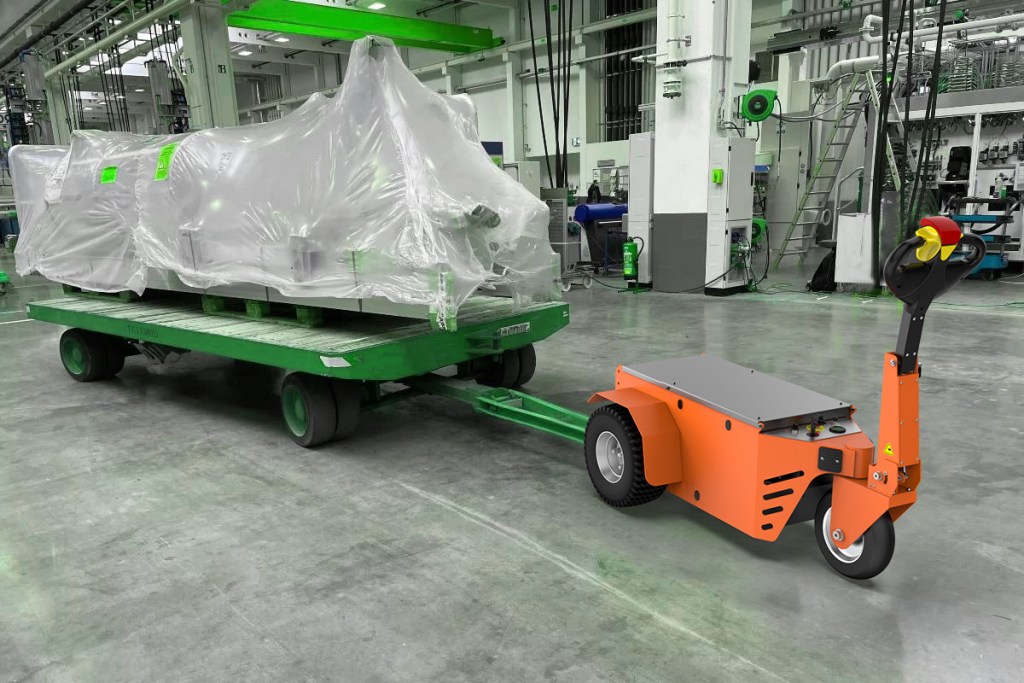
As one of the key devices in modern warehouse logistics, Rotontek electric transmission plays a rather important role in the electric tow tractors’ drive systems. An electric tow tractor is designed to perform transportation and towing operations in heavy conditions and high operation intensity. In this way, the electric transmission can better regulate power output to maintain the efficient running of Tugger.
The power system of an electric Tugger usually consists of an electric motor, transmission, and control system; the electric transmission is responsible for the precise regulation of the motor’s output. In a traditional mechanical transmission, the operator has to change gears manually, which may result in improper handling and inability to catch up with changes in the load in a timely manner. However, an electric transmission will be able to intelligently adjust the motor speed and power output based on real-time load, incline, road conditions, and other factors. The adjustment mechanism effectively avoids problems such as excessive load or insufficient power, ensuring the Tugger maintains optimal towing force and stability under different working conditions.
An electric Tugger able to work on a slope with the electric transmission automatically adjusting to power output when the load varies, hence preventing conditions that may make the vehicle stall either because of a lack of power or battery. Besides that, most electric Tugger have an efficient energy recovery system, wherein the electric transmission aids in recovering energy during braking; this improves the efficiency of energy use and prolongs battery life.
It will further coordinate with the control of the vehicle to automatically identify the running environment, with operational parameters dynamically adjusted accordingly for full-range optimum power output. For example, electric drive transmissions would reduce their output power during operations along the narrow passages of warehouses; by so doing, such sudden events may be easily avoided in the moving processes of these vehicles. Thus, an electric Tugger could complete tows in complicated conditions with slopes, varying loadings, or other kinds of complexities.
Efficiency Improvement of Electric Trolleys
Electric trolleys are widely used for material handling in warehouses. Equipped with intelligent adjustment through electric transmissions, they greatly improve operational efficiency and reduce energy consumption. Replacing a lot of manual labor, electric trolleys are used for frequent short-distance transport. The electric transmission should make sure that the device can intelligently adjust its power output based on the actual load and optimize its performance.
In traditional hand-pushed trolleys, the operator uses his physical strength to move goods, which is inefficient and tiring. Electric trolleys, however, have electric transmissions that automatically adjust their power output according to the load. For instance, when the trolley is loaded with a heavy load, the electric transmission increases power output to help the operator move heavy items; when the load is light, the transmission reduces power to extend battery life and reduce energy waste.

The efficiency of electric trolleys can be improved by more than 30%, especially in high-frequency handling environments where the adjustment functions of electric transmission are important. In such application scenarios, the electric transmission will intelligently perceive the load and ground conditions, adjust the speed and towing force in real time, and avoid excessive energy consumption or poor operation. Besides, most electric trolleys have intelligent control systems that will enable operators to view real-time information like battery level, speed, and load for efficient and accurate operation.
The introduction of Rotontek electric transmissions also leads to cost savings in maintenance. Compared with traditional mechanical transmission, an electric transmission is simpler in structure, has a longer maintenance cycle, and, through an intelligent system, is able to realize self-diagnosis and real-time detection of equipment status for preventing accidents that cause stopping. As electric trolleys are in wide use among warehouses, the electric transmission provides good technical support for performance optimization and efficiency improvements.
Application of AGV Electric Bridges
The AGV has grown to be an important part of today’s modern warehouses, most especially in material handling and automated transportation. Applying the electric transmission to an electric bridge of AGVs, it is able to give precise control over AGV speed, towing force, and load capacity while performing its operation stably and safely even in a complex environment.
Most of the time, the material handling of AGV electric bridges needs to be performed in a tight space. The electric transmission adjusts the output of the drive motor, allowing the AGV to easily adapt to varying loads, speeds, and ground conditions. Compared to traditional mechanical transmissions, electric transmissions not only provide smoother acceleration and deceleration but also automatically adjust power output to suit the constantly changing operational environment in the warehouse.

The automatic transmission automatically gains more power output when an AGV is loaded with heavier weights, ensuring firm and smooth towing of heavier goods. During light-load operation, the transmission reduces power to save energy and extend battery life. The electric transmission on the AGV electric bridge can receive the real-time task instruction given by WMS, switch its working state, and adjust the traveling path accordingly. Through intelligent control, the AGV can quickly respond to a change in a task and show high efficiency under different conditions.
With the intelligent development of AGVs, electric transmissions have become increasingly critical. They not only optimize power output but also collaborate with other automation systems in the realization of moving tasks in a more effective and energy-saving way. It can intelligently adjust the operating mode in real-time by monitoring the battery level and load condition, avoiding the situation of insufficient power or excessive consumption, reducing equipment failure rates, and lowering operation costs.
Besides that, the electric transmission of the AGV electric bridges works with the BMS to realize energy recovery and further improve the utilization efficiency of the battery. The above functions enable the AGV to operate steadily in complex work scenarios to ensure the smooth completion of material handling tasks.


