

By comparing BLDC motors with traditional DC motors, we will find that BLDC has a much higher degree of durability (more than most standard DC motors), efficiency and performance through their exceptional electric factor, which usually makes GB range 85%-90%, whereas this number typically falls within a range of 75 to eighty percent in the case connected DC Motor. BLDC motors also have a life that is 2-3 times longer than traditional DC motors and require less maintenance because of the brushless design. They enable rapid electric commutation through electronic handling with up to 0.1% accuracy, so they are used in precision applications when we must balance performance and acoustics (drones, EV). Moreover, BLDC brings the added benefit of noise reduction, which in turn cuts down operational sound to deliver a better experience.
Efficiency and Loss
Due to the brushless design, BLDC motors have higher efficiency than traditional DC motors, for long and high-speed loads in traditional DC motors, mechanical friction between brushes and commutators results in energy loss. This friction reduces mechanical efficiency and increases heat, affecting overall motor performance, data shows traditional DC motors usually have efficiency between 75%-80%, and under certain low load conditions, it can drop below 70%.


On the other hand, BLDC motors use electronic commutation technology, which reduces mechanical friction while maintaining high energy conversion efficiency under various operating conditions. BLDC motors are generally 85%-90% efficient, and in applications requiring efficiency as high as 92%, such as industrial equipment or electric vehicles, actual results show that in high-load continuous working conditions, energy consumption can be reduced by up to 20%, making it particularly advantageous in power-sensitive fields.
Lifespan and Maintenance
In traditional DC motors, brushes and commutators physically contact each other, leading to wear, especially under high speeds and loads, brushes usually need to be replaced every 1,000-3,000 hours. This increases maintenance costs and interrupts continuous machine operation efficiency.
BLDC motors have a much longer lifespan due to the elimination of brushes, experimental data shows that the average lifespan of a BLDC motor can be 2-3 times longer than traditional DC motors, even in harsh industrial applications, they can exceed 10,000 hours, while traditional DC motor brushes typically last around 3,000 hours. With less frequent maintenance required, BLDC motors are ideal for scenarios demanding high continuity and reliability, such as wind power generation, smart home products, and automated production lines.
Weight and Volume
Traditional DC motors are larger because they require complex mechanical structures like brushes and commutators, a 500W traditional DC motor usually weighs about 4-6 kilograms, while a BLDC motor of the same power level weighs only about 3-4 kilograms, reducing the weight by 20%-30%. The lightweight feature of BLDC motors provides significant benefits for applications where portability and flexibility are important, such as portable electronic devices like electric scooters or drones.
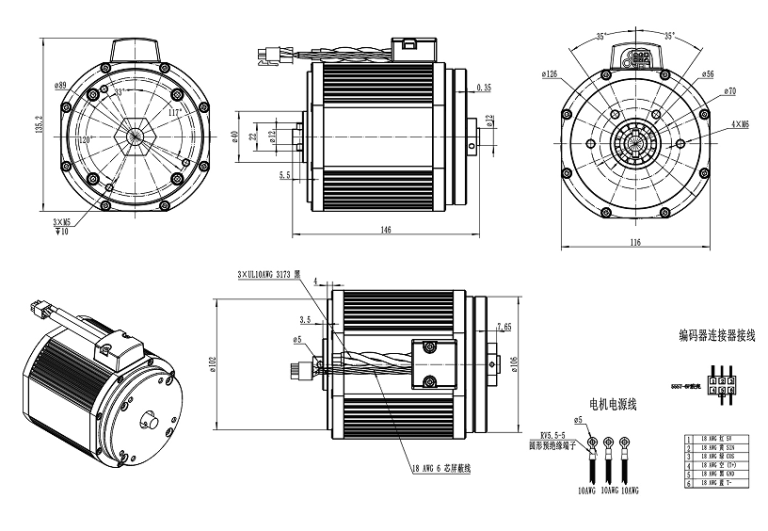
Since there are no brushes and commutators, BLDC motors can be smaller, data shows that the volume of BLDC motors is 15%-25% smaller than traditional DC motors, which is crucial for small-space devices. Smaller BLDC motors make room for more batteries, increasing the driving range of electric vehicles.
Control Precision and Response Speed
Traditional DC motor speed is usually controlled by adjusting the input voltage, while this method is simple, it can result in performance deviations when fine control is needed. Traditional DC motors have slower response times due to the physical limitations of brushes and commutators, generally taking over 100ms, while BLDC motors use electronic commutation technology, which allows control within 10ms by adjusting the current phase sequence, meeting the needs of high dynamic response scenarios.
BLDC motors also offer high control precision, they can be used with feedback systems like encoders or Hall sensors to achieve precise position and speed control, experimental results show that BLDC motor speed control accuracy can reach 0.1%, far exceeding the 1%-2% of traditional DC motors. This advantage has enabled BLDC motors to be widely used in drones, electric vehicles, and industrial robots, especially those requiring precise control and fast response. Controlled by feedback systems, BLDC motors can change speed and direction within milliseconds, ensuring smooth and precise operation of equipment.
[…] vehicles often work in complex environments: rain, dust, and extreme temperatures. Choosing a BLDC motor with an IP55 or higher protection rating is very important. In one security project, a batch of patrol vehicles […]