

The electrification wave is rapidly sweeping from passenger vehicles to various heavy-duty machinery. However, heavy-duty applications, with their unique operational demands, place far greater strain on drive systems than conventional equipment.
Many equipment manufacturers initially focus solely on motor power, overlooking the critical importance of integrated drive axle assembly matching. This oversight in selection is a root cause of insufficient power, premature motor burnout, structural failures, and poor overall energy efficiency.
This article provides a complete theoretical and practical selection methodology to help you precisely identify the optimal heavy-duty drive axle solution.
Performance Requirements for Heavy-Duty Electric Drive Axles
1. Power Output
The electric drive axle must not only propel the equipment under normal conditions but also deliver smooth, high-gradient starts under full load. The higher the gear ratio, the greater the starting torque, making “full-load hill starts” achievable.
2. Reliability
Subject to continuous vibration, dust ingress, and round-the-clock operation, the drive axle must exhibit exceptional fatigue life. The rigidity of the axle housing, the wear resistance of the gears, and the dynamic load capacity of the bearings directly determine whether the system can withstand vibration and heavy loads without fatigue failure.
3. Precision Control
When operating in confined spaces, power delivery must be finely tunable and responsive to ensure safe and accurate maneuvering. If backlash is excessive, even the most precise electronic control will result in mechanical slack and delayed response.
Selection Guide for Heavy-Duty Electric Drive Axles
Successful selection begins with rigorous physical calculations and operating condition analysis. The following are four core evaluation dimensions:
1. Equipment Load Assessment
As the foundation of selection, it requires the differentiation and quantification of two load types:
(1) Static Load vs. Dynamic Load
- Static Load: (Equipment Dead Weight + Rated Capacity). This determines the axle housing strength and suspension load-bearing capacity.
- Dynamic Load: Impact loads caused by road irregularities, rapid acceleration, or emergency braking. In heavy-duty scenarios, dynamic loads can reach 2–3 times the static load, acting as a primary cause of axle deformation or gear fatigue fracture.
(2) Critical Torque Calculations
- Starting Torque: Must overcome static friction; typically, the torque required to break inertia far exceeds steady-state running torque.
- Grade Climbing Torque: The wheel-end torque required to counteract gravity based on the maximum incline angle and total mass.
- Traction Torque: For towing applications, this includes the rolling resistance and aerodynamic drag of the trailed load.
2. Power and Torque Matching Principles
(1) Rated Power vs Peak Power
Rated power determines continuous operation endurance and thermal balance; peak power determines the ability to overcome instantaneous obstacles.
(2) Speed Ratio Requirements
Heavy-duty does not mean simply pursuing low speed. A reasonable reduction ratio must balance maximum speed with low-speed climbing stability. Heavy-duty equipment typically pursues “low speed, high torque” rather than high speed.
3. Control System
The motor controller’s (MCU) field-oriented control algorithm directly affects drive “smoothness.” A good controller paired with a suitable drive axle enables stepless speed regulation, anti-rollback functionality, and improved response speed—fundamental for precise heavy-duty equipment maneuvering in confined spaces.
4. Environmental and Durability Considerations
(1) Ingress Protection (IP) Rating
Construction machinery and agricultural equipment must consider waterproof and dustproof capabilities.
(2) Operating Environment
- High-Temperature: Requires high-grade insulation and specialized heat-resistant grease.
- Extreme Cold: Must account for low-temperature start-up characteristics and avoid materials prone to cold brittleness.
- High-Impact Conditions: Needs reinforced bearing specifications and increased housing wall thickness to ensure a long service life.
How the Rotontek Electric Drive Axle Meets Requirements
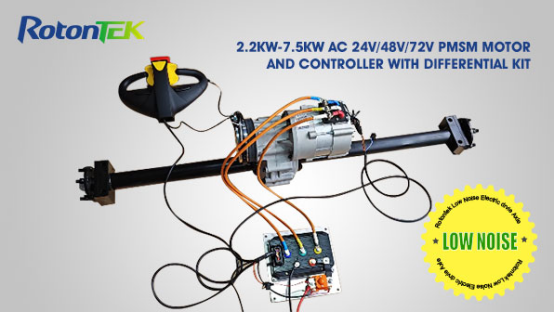
In respond to the stringent demands for power, durability, and precise control in heavy-load transportation equipment, our Rotontek 2.2KW-7.5KW BLDC Drive Axle integrates powerful performance with high efficiency, delivering a reliable solution.
1. Compact and High-Rigidity Design
This electric drive axle features a compact layout and reinforced structural design, ensuring overall rigidity and exceptional strength to effectively resist deformation caused by heavy loads.
2. Precision Wear-Resistant Gear Technology
The core transmission components—all-steel gearand theintegrated gear differential—are treated with special processes to achieve wear-resistant tooth surfaces.
This significantly enhances the gear’s fatigue strength while ensuring higher transmission efficiency is maintained during high-intensity, long-duration operation.
3. Powerful Output and Climbing Ability
Leveraging the characteristics of the BLDC motor and precise gearbox matching, it delivers strong and stable torque even at low speeds, ensuring ample power output and reliable climbing performance.
4. Excellent Efficiency and Low Noise
At Rotontek, weprioritize both power and environmental quality. By implementing precision gear tooth profiling and strict assembly tolerances, the operating noise is strictly controlled to ≤62dB.
Furthermore, the integrated differential optimizes energy consumption while enhancing maneuverability, realizing a balance of high efficiency, quiet operation, and smooth control.
5. Safety Protection
This 2.2KW-7.5KW electric drive axle integrates an advanced intelligent electromagnetic braking system.
In the event of a power failure or emergency, the brake responds quickly to achieve smooth and reliable braking, effectively preventing slope rollback and providing solid safety assurance for both personnel and cargo.
6. Flexible Customization Capability
Given the wide variety of installation spaces and performance requirements across different equipment, we offer in-depth customization services, allowing customers to adjust the rotational speed and shaft length according to specific needs.
Application Scenarios for 2.2KW-7.5KW Electric Drive Axle

1. Construction and Engineering Equipment
- Concrete Transport Trucks: Addressing the operational characteristics of frequent start-stops and short-distance heavy loads, the drive axle’s high peak torque ensures smooth, fully-loaded starts and prevents the motor from frequently entering thermal protection due to overloading, significantly improving equipment uptime.
- Building Material Handling Equipment:When operating in confined spaces like foundation pits or scaffolding, the precise BLDC control combined with the drive axle’s responsive feedback enables on-demand power delivery, allowing operators to maneuver effortlessly even in limited spaces.
2. Agricultural Machinery
- Agricultural Trailers:Facing rough terrain and muddy conditions in fields, the highly sealed structure effectively prevents mud and sand intrusion. Coupled with high torque output at low speeds, it ensures the trailer does not get stuck or fail due to slippage in challenging sections.
- Harvesting Machinery: It suppliesexceptionally stable power output during low-speed harvesting operations, reducing crop loss caused by speed fluctuations. Its excellent dustproof and waterproof design easily adapts to dusty and high-humidity field environments.
3. Specialized Transportation Equipment
- Glass Loaders:Glass weighing several tons is extremely sensitive to transportation stability. The silent drive axle’s ultra-low vibration characteristics effectively prevent cargo damage caused by resonance or impact.
- Heavy-Duty Material Handling Carts:Facilitates the zero-emission upgrade of factory logistics. The quiet operation eliminates the roar of traditional internal combustion engines in warehouses, while its robust load-bearing capacity enables efficient heavy-load transfer under demanding conditions.
Conclusion
Selection is not just about choosing a specification; it is about choosing a complete reliability engineering solution. Every Rotontek electric drive axle is born from a standardized production process. From raw materials to finished products, a rigorous quality control system ensures that each unit possesses exceptional quality and high reliability.