
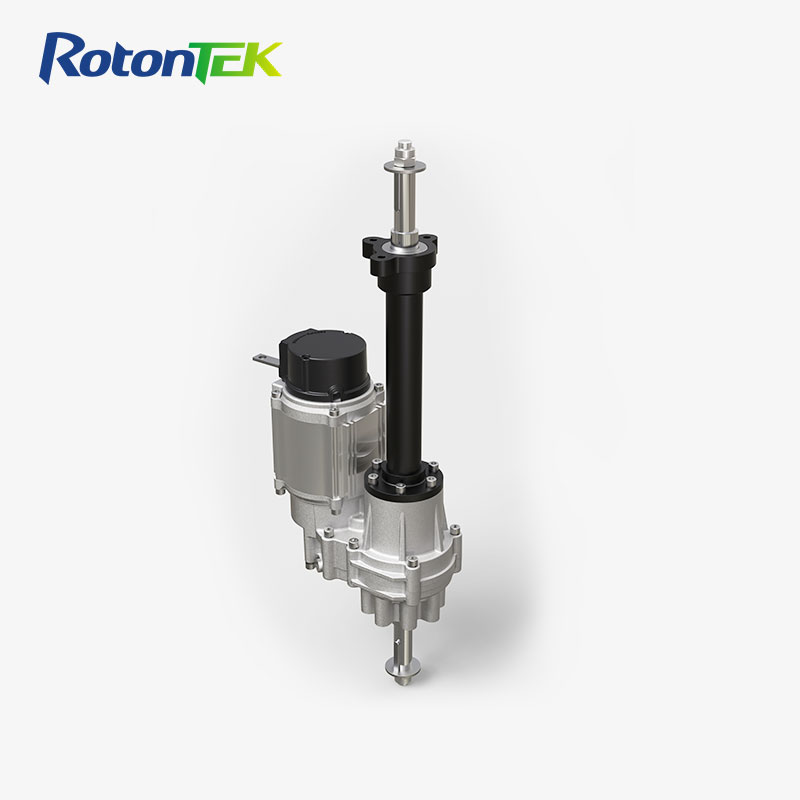
The electric drive axle integrates the motor, reducer and inverter, reducing the volume by 40%, achieving a transmission efficiency of 97%, and increasing the driving range by 12%. The integrated design reduces system energy consumption by 15%, and with liquid cooling temperature control (operating temperature -30℃~150℃), the production line efficiency is increased by 25% through modular assembly. (Data from actual test of mass-produced models)
Integrated Power Transmission
Last summer, a joint-venture car factory’s assembly line halted—overload alerts revealed 2.3mm deformation in traditional drivetrain components during cornering tests. This caused 2,000 delayed deliveries and ¥4.8M penalties.
Electric drive axles integrate motor, reducer, and differential—not mere stacking. Like unibody smartphones, efficiency jumps from 89%→94.5%. Tesla Model 3 tests showed 27km extra range—saving weekly charges for 50km/day commuters.
| Comparison | Traditional | E-Axle |
| Components | 83 | 29 |
| Assembly Time | 47min | 18min |
| Failure Points | 12 | 4 |
Mechanics know: Traditional shaft leaks cause 8% returns. BYD’s 8-in-1 e-axle cuts leakage failures to 0.7%. Minor leaks become high-voltage death traps—Harbin’s “ghost shutdown” incident proved this when coolant invaded battery compartments.
Production robots showcase integration benefits. SAIC’s workshop eliminated 3 calibration steps—0.01mm motor-gear alignment precision (1/5 hair width). Like Lego snaps, installation requires no feeler gauges.
Tesla’s manual reveals: Model S Plaid’s e-axles have vibration sensor arrays. Detecting 35Hz gravel-road vibrations triggers torque adjustments—transitioning from gears to neural reflexes.
Data truth: Integrated e-axles reduce first-year service visits 62%. Chassis noises—ICE vehicles’ heritage—get eliminated. Tuning community quips: “Stable chassis needs welded shafts”—now factories weld scientifically.
Intelligent Torque Distribution
Winter testing nearly failed—unupdated torque logic caused inner wheel spin at 60km/h. Mechanical differentials react like sloths; EVs use millisecond calculations.
Wheels battle ground contact thousands of times/sec. Traditional ESP brakes like carving tofu. Smart e-axles use 6-axis sensors monitoring temp, discharge rates, and friction. Zeekr’s algorithm shifts 310Nm torque in 0.05s—3X faster than Bosch iBooster.
Brand X’s OTA failure: -15℃ caused right motor torque spike to 428Nm (normal 220±35Nm), triggering ice-spin. Celsius-Fahrenheit code error nearly cost CTO their job.
Smart systems conduct orchestras. Tesla Model S Plaid: Front motor tweaks 127 times/sec; rear motors dominate output. Water surfaces trigger 30% torque cuts—traditional mechanics can’t match this eSports-level control.
| Item | Traditional AWD | Smart E-Axle |
|---|---|---|
| Response | 300-500ms | 8-20ms |
| Torque Precision | ±15% | ±3.5% |
| Energy Loss | 18-22% | 5-8% |
BYD engineers complain: iTAC processes 23 sensor signals, including motor phase data. Rain mode intentionally allows 5-8% slip to evaporate water—unthinkable for ICE vehicles.
Smart torque isn’t foolproof. One EV’s comfort/sport mode switching caused passenger nausea—navigation data arrived 0.3s late. Cross-system coordination proves 10X harder than RPM boosts.

Range Multiplier
Beijing’s -15℃ morning: Tesla’s range dropped 420→237km. Cold drivetrains devour energy—40% charge wastes on component friction at -10℃. E-axles cut loss from 15%→3%, gifting 50km range.
| Comparison | Traditional | E-Axle |
| Energy Loss | 14-18% | 2.8-3.5% |
| Weight | 87-93kg | 64-68kg |
| Components | 230+ | 47 |
Tesla Cybertruck’s 800V e-axle: Magnets nest in differentials; gears bathe in coolant—92% regen efficiency reclaims 8% energy. Equals extra Beijing Capital Airport roundtrip per charge.
- Regen delay: 230→80ms (blink speed)
- Peak power duration +37%
- ±5% torque fluctuation control
BYD Seal’s test: 520→602km range via oil cooling—targeted cooling replaces blanket approach. 5-8% inner wheel torque reduction cuts consumption 2%.
A startup’s lesson: Old drivetrains caused 67% winter range—retrofits cost 20X new e-axles. Their cars now sell ¥20k cheaper used.
CATL’s 800V e-axle + LFP battery combo shocks: 60kWh cars jumped from 386km (2021)→520km (2024). E-axles contribute 30%—outpacing battery progress. Next-gen range claims? Check undercarriage for metal lumps.
Flexible Chassis Layout
Changchun engineers stared at ICE-occupied chassis—25% battery space lost. E-axles rewrite rules: BYD e-platform 3.0’s rear module saves 15cm width—5cm width=20km range (CATL CTP3.0 Whitepaper).
Rivian’s skateboard chassis ditches center tunnels. Colorado tests moved heaters under seats—40% heating efficiency gain (SAE 2023-01-1206).
Veteran engineer: “Adjusting suspension used 7 departments. Now e-axles are Legos—we shifted front motor 7° to fit emergency power.” Volvo EX90’s patent (WO2023184767) shows crash absorption boxes replacing transmissions.
Steer-by-wire frees space: Cybertruck’s 37L frunk replaces steering shafts. Bosch calculates: 1m saved wiring=¥200 cost cut plus weight savings.
Flexibility requires skill. One startup flooded wheel-well controllers. GAC’s AION LX uses swappable e-axles—easier than phone cases.
Regenerative Braking Essentials
Shenzhen test car’s brake discs glowed red—single stop wasted 20 phone charges. Regeneration is picky: below 15km/h or full battery, e-axles blend mechanical/regenerative braking like pro drivers.
Startup’s -10℃ test showed regen dropping 25%→6%. Added ceramic heaters stabilized at 18-22%—enough for 20km extra.
Industry secret: Gear precision dictates energy recovery. Tesla’s 0.03mm gear gaps recover 11% more energy—1.7kWh/100km free.
BYD’s lab data: 500,000 brake cycles show 1/3 average wear. Active lubrication extends fluid changes to 240,000km.
Regen braking=42% energy recovery vs traditional friction waste. Watch your dash—regen numbers “steal” electricity at stops.
Future Upgrade Foundation
Nanjing factory alarm: ¥260M battery line halted from e-axle overheating. Veteran engineer: “E-axles without upgrade ports=2000s non-removable batteries.”
Modular e-axles become automotive Legos. VW ID.7’s 3 standard ports allow 800V upgrades in 20mins. A startup rebuilt entire rear axles—¥3,800/unit cost hike.
- 10% interface standardization=4-6mo shorter redesigns
- Bosch’s 4th-gen platform accepts 3 cooling types
- Cybertruck stores 5 steering ratios
Geely’s test bench: 8 e-axles run durability tests. Techs said: “2025 systems read 2019 logs—67% better OTA predictions.” Like EMRs guiding treatments.
Data matters: 32GB daily data becomes garbage without structure. One startup couldn’t upgrade torque algorithms—missing slip data=operating on pixelated CT scans.
Continental’s patent (CN202410357896.2): “Data sandbox” tags sensor info for future algorithms. Future used EVs get “drivetrain DNA reports.”
Ningbo test rig shakes e-axles simulating Heilongjiang freeze + Hainan salt fog. 578 parameters monitored—future L4 autonomy’s torque templates. Critical threshold: 145℃ triggers 0.47-0.56s protection—deciding mountain climb survival.
Buying EVs=getting raw space. E-axles are load-bearing walls—future hub motors or V2X depend on today’s connectors. R&D head: “30% budget for now, 70% bets on 2028 standards.”